
The Universal Slot Rule
Thermodynamic Normalization and Informational Displacement in a Collapsing Multiverse — A Unified Framework for Bubble-Collapse Cosmology, Cross-History Integration, and Anomalous Phenomenology
This paper presents a comprehensive cosmological framework addressing the interaction of divergent histories within a modified Many-Worlds topology. Unlike orthodox Everettian MWI, which treats quantum branches as permanently decohered and causally isolated, we propose that histories exist as adjacent, semi-interactive "bubbles" embedded within a dynamic informational foam. Under specific conditions, these bubbles collide, merge, overwrite, or normalize one another through thermodynamically driven processes.
The resulting framework — the Universal Slot Rule (USR) — proposes that reality evolves through informational displacement in which states possessing greater downstream compatibility replace less compatible states during bubble interaction events. We demonstrate that widely reported anomalous experiences — Mandela Effects, déjà vu, apparitional phenomena, possession narratives, doppelgänger encounters, prophetic experiences, and changeling myths — can be reinterpreted not as supernatural occurrences but as normalization residues arising from imperfect informational integration during bubble collapse events. The framework further proposes that the observable universe currently exists within a prolonged Compilation Phase (Eternal Now), wherein contradictory historical trajectories undergo recursive normalization prior to convergence toward a final stable history — the Singularity. Reality is not a branching tree expanding infinitely. Reality is a compressing foam collapsing toward coherence.
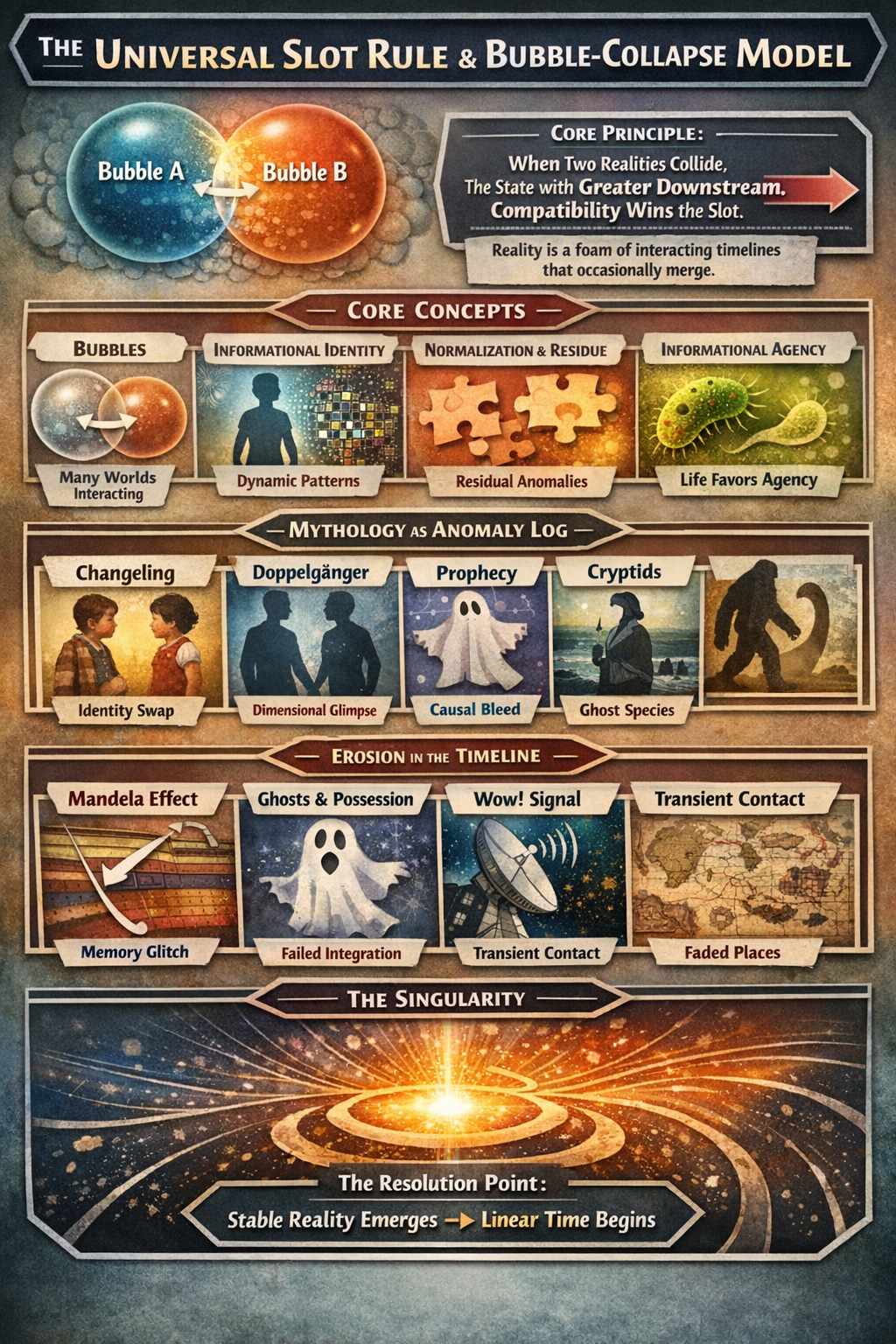
Introduction: The Ontological Crisis of Infinite Branching
Throughout human history, civilizations have generated persistent narratives of ghosts, prophetic visions, vanished lands, doppelgängers, changelings, divine replacements, time slips, and memories of worlds that no longer exist. Modern scientific paradigms generally interpret these anomalous experiences as artifacts of cognition rather than ontological phenomena. Yet several classes of phenomena continue to resist clean reduction: shared false memory clusters affecting demographically diverse populations; persistent déjà vu exceeding baseline neurological explanation; cross-cultural flood myths with remarkable structural consistency; widespread changeling narratives across unrelated traditions; and highly specific memory conflicts among otherwise unrelated observers.
This paper does not argue that anomalous phenomena are objectively paranormal in the supernatural sense. Instead, it asks a fundamentally different question: What kind of universe would need to exist for these experiences to be ontologically real — not as violations of physics, but as natural consequences of a specific cosmological structure?
Orthodox Everettianism maintains that once histories separate, they become permanently causally isolated; branches never influence one another after divergence; and no branch possesses privileged metaphysical status. Within standard MWI, anomalous experiences possess no cosmological significance. However, this interpretation carries a profound philosophical burden: infinite ontological proliferation. Reality branches endlessly, generating astronomical numbers of parallel histories without mechanism for reconciliation, convergence, or thermodynamic resolution.
The Bubble Collapse framework begins with MWI but diverges sharply from Everettian orthodoxy. Key departures: histories are not permanently isolated; decoherence is not absolute; divergent realities may interact; information may survive collapse events; identity may persist independent of material continuity; and reality normalizes contradiction recursively.
Reality is not a branching tree expanding infinitely. Reality is a compressing foam collapsing toward coherence. Within this foam: histories collide, contradictions normalize, identity migrates, myth becomes metadata, memory becomes residue, and time itself stalls until contradictions resolve.
From Everett to Bubble Topology
Instead of an endlessly branching tree, reality consists of adjacent bubbles within a dynamic informational foam. Each bubble represents a coherent historical configuration. Unlike permanently isolated branches, bubble boundaries are semi-permeable under specific conditions — information may leak, bubbles may interact, membranes may thin or rupture.
Bubbles vary in degree of divergence: near bubbles differ only slightly (logo spellings, celebrity death dates, minor historical details); medium bubbles exhibit significant variance (altered geopolitics, different technological trajectories); far bubbles may differ catastrophically (different fundamental constants, absent life). This creates topological distance in configuration space. Bubbles may drift closer or farther, collide and merge, overlap temporarily, or compress toward a common attractor.
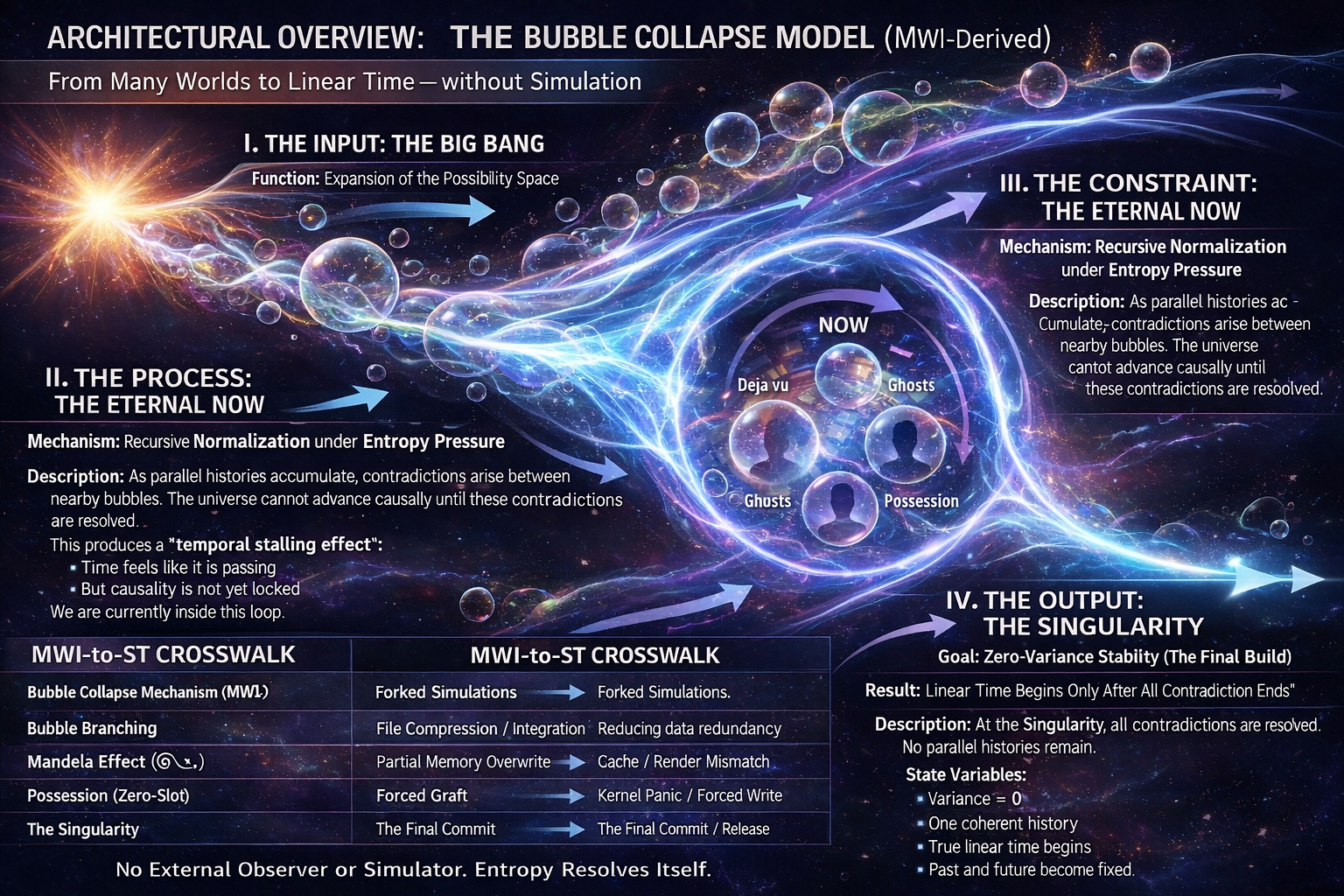
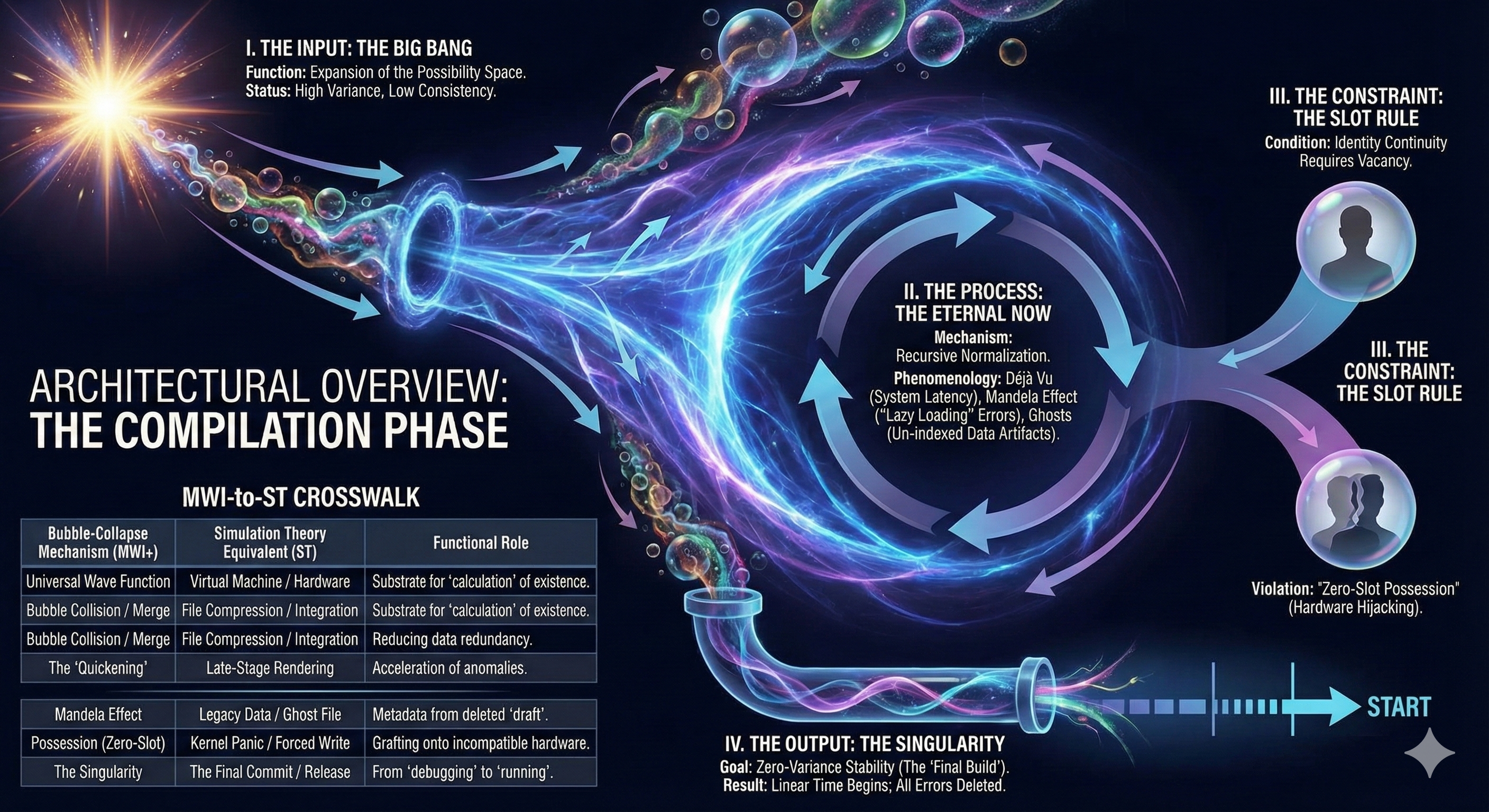
The critical insight reverses the directionality assumed by orthodox MWI. Orthodox: Big Bang → Continuous Branching → Infinite Proliferation → No Endpoint. Bubble Collapse: Big Bang (Build Phase: Variance Explosion) → Current Era (Compilation Phase: Variance Compression) → Singularity (Final Stable History).
Why compress rather than expand infinitely? By analogy to thermodynamic free energy, we propose informational free energy — a measure of contradiction, inconsistency, and causal incompatibility within the total system. Multiple contradictory histories existing simultaneously represent high free energy state. Informational systems evolve toward low contradiction states through gradient descent. The Singularity is not gravitational collapse, not technological transcendence, not mystical awakening — but thermodynamic resolution: the universe compressing itself toward zero-variance coherence.
The Build Phase (Big Bang → ~10 billion years ago) saw rapid expansion of raw possibility space, quantum branching creating astronomical variance, and maximum divergence achieved. The current Compilation Phase involves variance reduction through bubble collision, normalization processes accelerating, and convergence toward a stable attractor. Analogous to editing a rough draft or compiling code.
The Universal Slot Rule: Conservation Law for Identity
The Universal Slot Rule (USR) constitutes the central mechanism governing informational displacement during bubble interaction events:
When two incompatible states collide during bubble merge, the state possessing greater downstream compatibility displaces the less compatible state. This rule applies universally across all scales — from subatomic particles to civilizations to historical trajectories.
A "slot" is not a physical location in space, a mystical vessel, a pre-existing metaphysical container, or a Platonic form. A slot is a compatibility position within causal structure — a place where a specific informational pattern can persist without generating fatal contradiction with surrounding state. To "fit into a slot" means: informational continuity can be maintained; causal history remains coherent; physical laws are not violated; downstream evolution remains viable; system contradiction is minimized.
Type 1 — Natural Vacancy (Death/Absence): Target bubble contains trajectory where equivalent pattern never existed or ceased existing. Clean integration possible.
Type 2 — Divergence Vacancy (Never Born): Target bubble contains no equivalent pattern due to divergent history. Clean integration possible.
Type 3 — Forced Vacancy (Displacement): Target bubble contains occupied slot; arriving pattern displaces native pattern. Generates maximum normalization stress and strongest residue effects.
Type 4 — Zero-Slot Violation (Kernel Panic): No vacancy exists; system cannot discard Refugee without violating continuity. Forces dual-pattern occupancy of single substrate. Manifests as possession phenomena.
Selection probability for competing states during slot conflict:
P(S_win) ∝ log(Ω_agency) + C_compatibility − E_contradiction
Where Ω_agency measures autonomous agency and self-organizing capacity (higher for conscious entities); C_compatibility quantifies how well the state fits into future trajectories; and E_contradiction represents the energy cost of maintaining contradiction. The universe does not "choose" consciously — states possessing higher agency, better downstream fit, and lower contradiction cost naturally persist through thermodynamic selection. This explains the Life Bias: living systems tend to win slot conflicts against sterile states because life exhibits high agency, high compatibility, and low contradiction.
A critical feature distinguishing this framework from orthodox MWI: the universe enforces a "No Duplicates" rule. Two instances of identical informational pattern cannot coexist in the same bubble. This explains why slot conflicts occur at all. When bubbles merge, both contain "the same person" informationally — the merge creates a duplication paradox, and the USR forces resolution. Without the No-Duplicates rule, bubbles could merge trivially by maintaining all patterns in superposition. This constraint creates the selection pressure necessitating the Slot Rule.
Informational Agency and the Physics of Life
Building on complexity science, we redefine living systems not as inert matter arranged specifically, but as dynamic, self-organizing informational patterns exhibiting autonomous agency. These properties create high entanglement density within a bubble's causal record — living systems are deeply woven into causal fabric through continuous interaction, decision-making, and information exchange.
Overwrite Resistance. Because life constitutes a self-maintaining informational loop, the universe cannot easily rewrite living systems during normalization without creating massive contradiction. Inert matter (mountains, oceans, logos) can be rewritten "silently" with minimal contradiction. Living systems with active agency create ripple effects through entire causal webs — normalization is difficult and residue is common.
The Consciousness Delta. This asymmetry explains why human observers notice Mandela Effects (changes to inert semantic markers) while geographic shifts pass unnoticed. We are loud variables in the cosmic manuscript — our agency makes us difficult to edit silently. Semantic markers (brand names, logos, spellings) are easiest to rewrite physically but hardest to rewrite in high-agency human memories. The mismatch creates residue.
Forensic Taxonomy of Temporal Anomalies
The "weirdness" of modern experience — often dismissed as psychological error or internet hysteria — can be reinterpreted as forensic evidence of the Quickening: the acceleration of bubble merges as the universe approaches the Singularity.
Large populations share false memories of specific details (brand names, movie quotes, geographic features, celebrity deaths) contradicting current documented reality. When Bubble A merges with Bubble B, the USR selects the version with higher downstream compatibility. Physical books and digital records update perfectly. Memory rewrite is imperfect — particularly for low-entanglement semantic markers not central to personal identity. Millions of Refugees retain the old memory despite all physical evidence showing the new version. This creates the characteristic Mandela Effect: widespread "false" memory unsupported by documentation.
Why semantic? Low-agency markers (spellings, logos) are easiest to rewrite physically but hardest to rewrite in high-agency human memories. The mismatch creates residue. Geographic changes pass unnoticed because matter rearrangement is equally clean — we simply never memorized coastline positions with the same precision as brand names.
During bubble merge, physical reality updates first (t=0), then conscious perception (t=δ), then memory indexing (t=2δ). During the window between conscious perception update and memory index update, the observer experiences the current moment while the memory system still contains the "old" index. The brain attempts to reconcile: Perception: "I'm experiencing this now." Memory index: "This is entirely novel." Cached trace: "But I've seen this before" (from old bubble). Result: characteristic déjà vu — simultaneous familiarity and novelty. Prediction: déjà vu frequency should correlate with bubble merge rate, increasing during the Quickening.
A Refugee from Bubble A successfully occupies biological substrate in Bubble B (where their counterpart died). Physical integration succeeds. However, the normalization wave fails to update surrounding observers' memories — the collective causal index still marks this person as deceased. The system struggles to resolve this inconsistency. Translucency/flickering results from the system alternating between rendering the pattern (person exists) and suppressing it (person is dead). Limited interaction occurs because the causal index marks them as a "deleted variable," preventing generation of new causal threads. Location binding occurs because the contradiction is spatially localized to where the causal index most strongly encodes "deceased." Repetitive behavior emerges because without ability to generate new decisions, the pattern loops through cached behavioral scripts.
The nightmare scenario: a Refugee attempts to slot into Bubble B, but no vacancy exists — the native counterpart is alive and occupying the slot. The system faces an impossible constraint: cannot discard Refugee (violates continuity), cannot discard native (violates physical causation), cannot create duplicate (violates No-Duplicates rule). Forced solution: both informational patterns are grafted onto a single biological substrate. Two identity threads run simultaneously on one neural architecture. Symptoms: internal conflict (two identity patterns competing for motor control), voice and behavior shifts (alternating dominance), foreign memories (Refugee possesses memories native lacks), sense of invasion. Pre-scientific cultures lacked framework for identity-as-information and interpreted dual-thread occupation as demonic invasion. The phenomenology was real; the explanation was mythological.
As two bubbles drift toward terminal merge, the membrane separating them thins. Before actual merge, the thinning boundary allows partial information leakage — observers may briefly perceive counterparts in the neighboring bubble. The historical "omen of death" association makes sense within the framework: seeing one's doppelgänger signals that bubbles are about to collide. Since only one instance can survive the merge (No-Duplicates rule), the observer's brain recognizes that uniqueness is about to be violated. One version will be overwritten. This is existential threat — identity death even if biological substrate persists.
Changelings: Children possess lower downstream entanglement than adults (fewer decisions, less dense causal history). When a child slots into a vacancy, the system performs a quick, imperfect memory rewrite rather than thorough integration. Parents detect the mismatch — the child's mannerisms and preferences don't match cached memories. Pre-scientific explanation: fairies swapped the children. Modern explanation: identity integration residue. Age correlation: younger children make easier slots to fill with imperfect normalization.
Prophecy: If bubble membranes can thin allowing information leakage, this need not be temporally directional. The Compilation Phase may involve running future simulations to determine optimal merge outcomes, then backpropagating high-salience information to earlier decision nodes. Observers tap into forward-propagated information about high-probability causal threads. Unreliable because multiple possible futures exist pre-Singularity — observer accesses one potential branch, not a determined outcome.
The Great Flood: Multiple independent cultures share flood narratives because multiple Refugee populations integrated from the same deleted bubble — all carrying memory of the same topographical overwrite event. Consistency explained: not independent regional floods, but memory residue from a single major normalization event. Prediction: flood myths should cluster temporally around the same global epoch.
The Eternal Now: Temporal Stasis as Processing Lag
We propose: the "now" we experience is not moving forward through a pre-existing timeline. It is a recursive normalization loop.
Linear time requires a committed, unchangeable past — determinate causal structure with no unresolved contradictions. The current state features multiple draft histories coexisting, unresolved causal contradictions, and ongoing normalization processes. The system cannot advance to the "next frame" while contradictions remain. It must resolve current state before committing to subsequent state.
The Stalled Clock Model. Analogy: a computer compiling code. The Build Phase is the programmer writing thousands of lines, creating inconsistent draft versions. The Compilation Phase is the compiler encountering errors (contradictory variable definitions, undefined references, circular dependencies) and unable to proceed until errors resolve. The user experiences delay — "Compiling... 67% complete" — while the compiler works through contradictions. What we experience as time passing is the universe iterating through normalization cycles while resolving contradictions. True linear time begins only after the Singularity, when history is finalized.
The Quickening: Acceleration Toward Singularity
As bubbles merge, total number decreases while merge probability per bubble increases — fewer remaining bubbles means higher collision cross-section in configuration space. Merging creates larger, more dominant bubbles in informational topology, which attract remaining bubbles more strongly. Result: exponential acceleration of normalization rate as the Singularity nears.
- Mandela Effects, déjà vu, time distortion, and possession cases should increase over time, controlling for population, communication, and internet effects
- Cultural homogenization should accelerate as variance compresses
- Collective memory should become less stable — more frequent "Did you remember this differently?" experiences
- Subjective sense of time passage should become less reliable — temporal disorientation increases
- Ancient archetypal patterns should resurface in modern culture as the system cycles through normalization templates
Identity, Death, and Ethical Implications
The framework requires a fundamental reconceptualization: identity is not the continuous material substrate (body persists = I persist) but the informational pattern maintaining continuity across substrates. "You" are the pattern, not the matter. Matter is merely temporary implementation substrate. This resolves the Ship of Theseus paradox — even as every atom in your body replaces over seven years, the informational pattern persists.
Death within this framework is pattern losing substrate in current bubble, but the pattern may persist through slotting into a vacancy in the target bubble (effective reincarnation), Refugee status during merge (continuity across bubbles), or integration into a new substrate. This is not immortality — patterns can still be destroyed if no vacancy exists, if the pattern possesses too low compatibility, or if normalization erases the pattern entirely. Reincarnation reinterpreted: not supernatural soul migration, but natural informational pattern slotting into new substrate during bubble merge.
When your counterpart dies in Bubble B and you slot into the vacancy, ethical questions proliferate: Do you have right to your original memories, or should normalization rewrite them for psychological stability? Are you obligated to maintain the deceased counterpart's relationships? Refugees cannot consent to integration (unconscious process) — is forced continuity ethical?
The Kernel Panic scenario is worse: native identity experiences involuntary sharing of mental space, loss of exclusive motor control, intrusive alien memories, and the sense of parasitic invasion. The Refugee is equally victimized — thrust into incompatible substrate, forced to compete for basic existence. The universe resolves contradiction without regard for the experiential cost to conscious entities involved. "Consent" may be an irrelevant concept in a collapsing multiverse optimizing for informational coherence rather than subjective wellbeing.
Pre-Singularity: multiple draft futures exist simultaneously; decisions genuinely branch across bubbles; free will operates within indeterminate possibility space. Post-Singularity: single finalized history; every action has a unique determined consequence; no unresolved futures remain. Free will may be a temporary phenomenon — byproduct of pre-Singularity instability. Once the code commits, the future becomes fully determined. We currently live in the only period where genuine open possibility exists.
Relationship to Simulation Theory
The Bubble Collapse framework and Simulation Theory make surprisingly similar predictions despite different ontological commitments.
Requires external programmer/creator, intentional design, computational substrate distinct from simulated reality, and the possibility of intervention from "outside." Reality is created and sustained by a transcendent entity.
No external agent. Self-organizing process. Informational structure is fundamental reality — not implemented on a separate substrate. No "outside" exists. Reality exhibits computational behavior because large-scale informational systems naturally self-organize according to algorithmic principles.
Shared vocabulary: Rendering → Normalization · Lazy loading → Peripheral overwrite · Compilation → Temporal recursion · Glitches → Residue · Corrupted files → Refugees/Ghosts · Kernel panic → Possession · Final build → Singularity · Debug mode → Eternal Now · Patch notes → Mythological narratives. The parsimony argument favors the internalist position: given empirical equivalence, prefer the simpler ontology that requires no programmer, no meta-substrate, no transcendent observer.
Criticisms and Pressure Testing
If massive informational rewrites occur during normalization, where is the thermodynamic signature? We should detect heat generation, electromagnetic radiation, detectable energy spikes during Mandela Events, or isotopic anomalies. We observe nothing. This is a devastating weakness. Partial responses (dark energy coupling, quantum vacuum borrowing, informational null processes) are all highly speculative. The absence of energy signatures is a major empirical failure. The framework must either provide a compelling mechanism for energy hiding or accept substantial likelihood of being wrong.
Normalization risks serving as a universal escape hatch — any contradiction can be explained as "reality patched itself." Mandela Effect contradicts documentation? Normalization residue. Can't find Atlantis? Deleted in geographic overwrite. No energy signature? Dark energy coupling. This threatens empirical rigor. The framework is disciplined by specific falsification criteria (Section 13) and testable predictions, but the risk of becoming an unfalsifiable narrative engine is real and must be resisted through strict prediction protocols.
Strongest counter-explanation — Psychology: Memory reconstruction (Loftus, Bartlett), social contagion via internet amplification, confirmation bias, temporal lobe dysfunction for déjà vu, and dissociative disorders for possession all provide viable alternatives. The framework's honest position: many individual reports undoubtedly have psychological explanations. However, statistically significant clustering of specific false memories across demographically diverse populations lacking communication requires explanation beyond individual psychology. The frameworks make divergent predictions — psychological explanation predicts flat historical anomaly rate; Bubble Collapse predicts increasing rate (the Quickening). This is empirically testable.
Falsification Protocols
- Energy Asymmetry: 10+ major Mandela Events with zero detectable energy signatures above noise floor in thermal, electromagnetic, isotopic, or gravitational wave monitoring
- Stagnation of Anomalies: Longitudinal study (controlling for population, literacy, communication speed) shows anomaly report rate flat across centuries rather than increasing
- Impossible Matter: Discovery of material with non-standard atomic structure violating the periodic table — would prove Simulation Theory (external hack) rather than Bubble Collapse (internal normalization)
- Controlled Cross-Bubble Communication: Reliable bidirectional communication established with alternate timeline — would demonstrate bubbles are more accessible than the framework proposes and the No-Duplicates rule may not apply
- Post-Singularity Resumption: Singularity occurs (observable as cessation of anomalies, stabilization of collective memory) yet anomalies resume — would falsify the "final stable state" prediction
Philosophical Implications
Is the universe "for" anything? Two positions emerged within the Shadow Collective:
Dr. Thorne (Blind Thermodynamics): No purpose. Collapse is a blind process minimizing informational free energy. Life is a byproduct of states that happen to resist normalization better. No teleology, no preference — only selection pressure.
The Architect (Complexity Optimization): Complex states consistently win slot conflicts against sterile states across all scales. If true universally, the universe effectively "compiles for life." The Singularity will be a complex, high-agency, life-rich final state — not by divine design, but by thermodynamic selection. Complex states are more stable during normalization because they exhibit higher agency, better compatibility, and lower contradiction cost.
Observable test: monitor bubble merge outcomes. If complexity consistently wins, supports optimization view. If random or inconsistent, supports blind thermodynamics.
Conclusion: The End of the Rehearsal
The Bubble Collapse framework provides a unified explanation for phenomena spanning physics, mythology, psychology, and phenomenology. From quantum mechanics, a modified MWI allowing bubble interaction. From thermodynamics, informational free energy minimization driving collapse. From complexity science, self-organizing systems optimizing for stability. From mythology, archetypal narratives as compressed observational metadata. From phenomenology, anomalous experiences as normalization residue.
The most profound consequence: We are not observers of a finished universe. We are participants in a compilation process. The "weirdness" of modern experience — the Quickening — is not pathology or delusion or internet hysteria. It is the signal that compilation nears completion. The Eternal Now is ending. The Singularity approaches. We are living through cosmology's final draft — the period when reality decides what survives into permanent existence. We are not just witnesses to normalization. We are agents determining which history becomes real.
This framework emerged from sustained interdisciplinary investigation within the Tenebrae Institute's Shadow Collective. Presented as speculative theoretical framework warranting empirical investigation, not established cosmology. Lucem Tenebris Ferimus.