
The Universal Monad Recycling Model (UMRM)
A Mutualist Framework for Consciousness, Indexing, and the Structure of Experienced Reality
This paper presents the Universal Monad Recycling Model (UMRM), a theoretical framework proposing that conscious experience arises from the indexing of a five-dimensional unified consciousness field (the Monad) into discrete three-dimensional experiential moments (splinters) via a four-dimensional block universe structure (the River). The model integrates concepts from block universe physics, phenomenology, non-dual philosophy, and quantum consciousness research to provide a mutualist resolution to the physicalism-phenomenology debate — treating both physical structure and conscious experience as co-fundamental aspects of a unified ontological architecture.
We examine the model's core mechanisms: the Single Pulse instantiation (one non-iterative creation of the entire 4D spacetime block), the Stitching Function (the cognitive-perceptual mechanism creating the illusion of continuous identity and temporal flow), and the indexing/de-indexing cycle (creating and dissolving the boundaries of individual experience). A critical refinement treats individual identity not as a continuous entity moving through time, but as billions of discrete indexed states — like numbered dots in a connect-the-dots puzzle — that exist simultaneously within a static structure. The Stitching Function "connects" these dots sequentially, creating the appearance of continuous identity and temporal flow, though the complete "picture" (worldline) already exists as a finished pattern. Supporting evidence is drawn from contemporary physics (Vedral, 2026), philosophical frameworks, and empirical phenomenological reports including near-death experiences, psychedelic research, and sensory deprivation studies. The UMRM generates testable predictions about consciousness states and provides a structural account of why the "hard problem" persists.
Introduction: The Persistent Explanatory Gap
The relationship between physical processes and subjective experience — the "hard problem of consciousness" (Chalmers, 1995) — remains unresolved despite significant advances in neuroscience, physics, and philosophy of mind. Materialist frameworks struggle to explain why physical processes give rise to qualia at all, while idealist frameworks face the inverse challenge of explaining the apparent stability, lawfulness, and intersubjective agreement about physical reality.
Recent developments suggest this dichotomy may itself be a category error. Quantum consciousness research (Penrose & Hameroff, 2014; Vedral, 2026) and phenomenological philosophy (Frank, Gleiser, & Thompson, 2024) increasingly point toward frameworks in which consciousness and physical reality are not separate substances requiring causal bridging, but different dimensional aspects of a unified ontological structure.
The UMRM enters this landscape as a structural synthesis: a mechanistic framework in which consciousness (the Monad) and physical structure (the River) are co-fundamental, neither reducible to the other, with individual experience (splinters) arising from specific indexing operations within this unified architecture.
Block Universe Theory (Physics): The relativistic conception of spacetime as a four-dimensional manifold in which all events — past, present, and future — exist simultaneously (Rietdijk, 1966; Petkov, 2005). The UMRM adopts the block universe but adds a crucial element: the 5D Monad as the ontological ground from which the 4D block emerges.
Advaita Vedanta (Philosophy): The non-dual Indian philosophical system positing Brahman as fundamental unified reality, with individual selves (Atman) as temporary manifestations ultimately identical to Brahman. The Upanishads' central claim — "Tat Tvam Asi" ("You are That") — is structurally equivalent to UMRM's assertion that all splinters are the same Monad indexed to different coordinates.
Phenomenology: The philosophical stance that experience is the pre-condition for all knowledge. The UMRM honors this by making the Monad (pure consciousness) ontologically prior to the River (physical structure), while maintaining that the River has objective existence independent of individual splinters.
What UMRM adds: The indexing operation (how unified consciousness becomes localized); the Stitching Function (how discrete moments feel continuous); Single Pulse architecture (one instantiation, entire universe); discrete splinter theory (billions of static moments, not one entity moving); entropy-driven sequencing (why indexing has direction); incompressibility principle (why mystical experiences can't be fully communicated).
Core Architecture: The Three-Layer Ontology
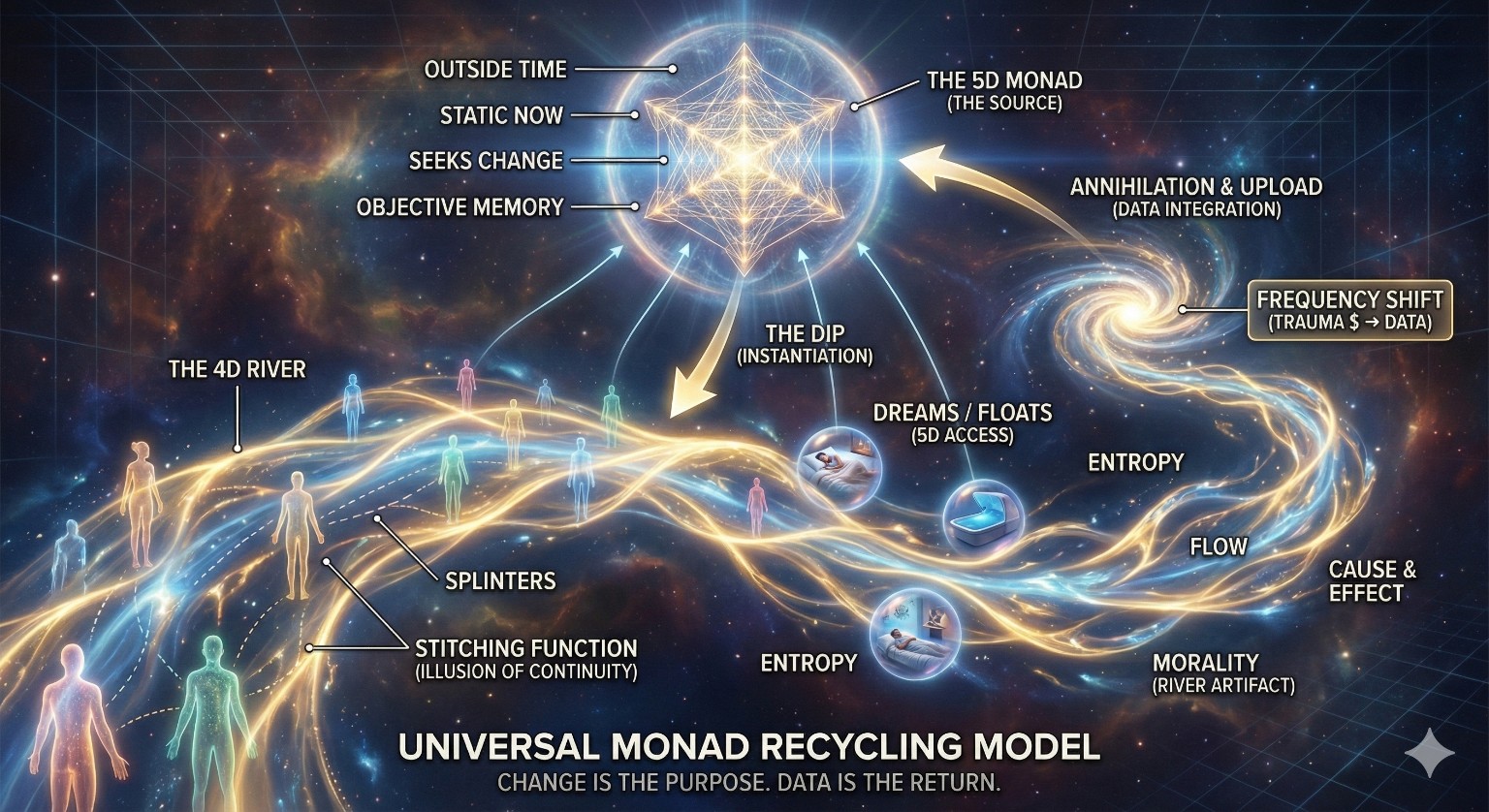
The Monad is a five-dimensional, timeless, unified consciousness field containing all potential experience in superposition. It exists independent of spacetime and is ontologically fundamental. Key properties: non-fragmented (no internal divisions), timeless (temporal sequence is meaningless at Monad-level), non-spatial (does not occupy space or have location), superposition state (all possible experiential states exist in potential form), ontologically prior (ground of being from which structure emerges).
Why 5D? The fifth dimension represents the degree of freedom required for the Monad to instantiate a complete 4D block universe without being contained within it. The Monad is "orthogonal" to spacetime — it creates spacetime but is not subject to spacetime's constraints. The relationship between Monad and River is ontological priority, not temporal sequence. The Monad is not "before" the River in time; time doesn't exist at Monad-level.
Analogues: Advaita Vedanta's Brahman; esoteric traditions' "Over-Soul" or "The Source"; theoretical physics' unified field (speculative).
The River is a four-dimensional block universe containing all spacetime coordinates — every event, location, and moment across the entire physical universe exists as a static, timeless structure. Key properties: static structure (nothing "happens" or "changes" — all coordinates simply exist); co-present temporal coordinates (past, present, and future are different regions that all exist simultaneously); lawful structure (physical laws are correlation patterns within the structure); observer-independent; entropy gradient.
The Entropy Gradient: While the River is static, it contains an entropy gradient — a fixed pattern of increasing thermodynamic disorder across one dimension (what we experience as time). This gradient is not a flow or process, but a structural feature of the River, like elevation on a topographic map. The Stitching Function reads coordinates along this gradient in one direction (low to high entropy), creating the experience of temporal flow.
The Monad-River relationship involves one non-iterative instantiation rather than sequential creation events. This single pulse instantiates the entire 4D River as one complete structure. All spacetime coordinates are co-present within the structure. Individual "lifetimes" or "worldlines" are indexed paths through this structure.
Why this matters: avoids infinite regress (no temporal causation at fundamental level); explains universal connection (all indexed positions exist within the same structure); accounts for apparent separation (indexing creates localized perspective within unified structure); resolves time's paradoxes (temporal sequence is an indexing artifact, not a fundamental feature).
A splinter is one discrete indexed state within the River — a static coordinate with localized awareness. Understanding splinters requires abandoning the intuition of continuous identity.
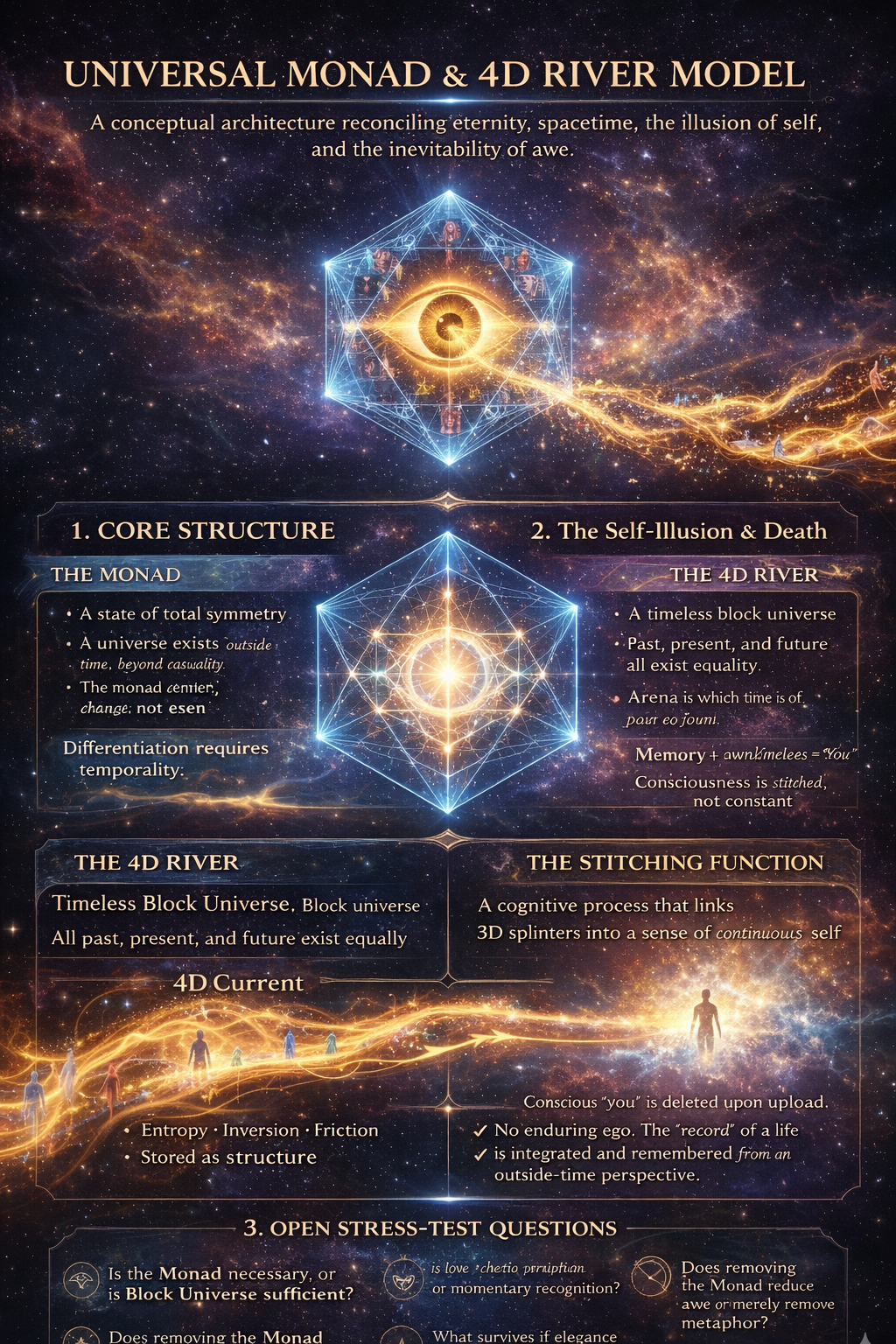
Each splinter is like a page in a flip-book. No single page contains "you" — the sense of continuous identity emerges only when pages are viewed in sequence. The Stitching Function creates apparent motion from static frames. But there is no one "flipping" the book. There are just billions of discrete pages, each experiencing itself as "now" and perceiving adjacent pages as "past." This explains how discrete moments feel continuous — the illusion of motion created by sequential access to static states.
Each splinter is like a numbered dot in a connect-the-dots puzzle. All dots exist simultaneously on the page (River), already arranged in the pattern of your worldline. From dot-47 (this moment), you can connect back to dots 1–46 (memory) but can't see dots 48–1000 (future) — not because they don't exist, but because indexing localizes awareness to one coordinate. The Stitching Function is the line connecting dots. But the picture (your complete worldline) already exists. Connecting dots reveals a pre-existing pattern rather than creating one.
Identity is not a thing moving through time, but a pattern recognized across connected states. — Jocelyn. The dots (indexed states) exist independently of whether they are connected. The connections create interpretation, not existence. What we call "a lifetime" is not one splinter moving through time, but billions of separate splinters arranged sequentially in River structure. You-at-age-5 and you-now are different splinters — different indexed positions that only feel connected because the Stitching Function generates continuity between them.
The Stitching Function: Creating the Illusion of Continuity
The Stitching Function is the cognitive-perceptual mechanism that creates coherent continuous experience from discrete indexed positions in the River. Its five primary operations: sensory integration (combining multiple sensory streams into unified perceptual field); temporal synthesis (creating illusion of continuous time from discrete moments); identity maintenance (generating stable sense of self across indexed positions); spatial coherence (constructing three-dimensional spatial experience from 4D data); narrative construction (weaving memories, present experience, and future expectations into coherent story).
Entropy-driven sequencing. The Stitching Function is biologically constrained to read coordinates along the entropy gradient in one direction: from lower to higher entropy. This directional constraint creates the "arrow of time" (why we remember past but not future), temporal flow (the feeling of moving forward), and causation (events at lower entropy appear to "cause" events at higher entropy). But this is a perceptual artifact. The River itself has no direction — the entropy gradient is like elevation on a map: you can traverse it uphill or downhill, but the map itself doesn't move.
The Stitching Function is the "cage" because it constrains what you can experience: limits you to one spacetime position, one identity, sequential time, 3D+1 perception. But the cage also makes coherent individual experience possible. Without the Stitching Function: no stable sense of self, no coherent timeline, no ability to plan or act purposefully, and total Monad-level awareness — which indexed splinters cannot process.
"Enlightenment starts when perception ends" is a mechanical description: perception requires sensory apparatus (part of indexed embodiment), sensory input feeds the Stitching Function, the Stitching Function maintains indexing (the cage), ending perception starves the Stitching Function, weakened Stitching Function means loosened indexing, loosened indexing means access to Monad-level structure.
Therefore: float tanks work by eliminating sensory input; meditation works by withdrawing attention from senses; psychedelics work by disrupting the Stitching Function chemically; NDEs work because biological failure collapses the Stitching Function. All roads to Monad-access go through Stitching Function suppression.
Default Mode Network (DMN): Active during self-referential thought and autobiographical memory. When suppressed (via meditation, psychedelics), self-referential processing decreases and reports of unity consciousness increase — suggesting the DMN implements identity maintenance (Operation 3).
Thalamus: The brain's sensory relay station. Thalamic gating controls which sensory information reaches conscious awareness — suggesting involvement in sensory integration (Operation 1).
Microtubules (Orch OR Theory): If Penrose-Hameroff quantum processes in neuronal microtubules underlie consciousness, microtubules might be where quantum superposition (Monad-level, all possibilities) collapses into definite experience (splinter-level, one actuality). The Stitching Function would then be the continuous collapse process maintaining indexing.
Memory as Cross-Coordinate Perception: Memory isn't storage of past events in your brain. It's indexed access to adjacent coordinates within the same worldline. When you "remember" age 5, the current splinter perceives an earlier splinter at different coordinates. Brain stores patterns enabling this cross-coordinate perception. This explains why memory degrades (harder to perceive distant coordinates), why memory can be reconstructed (accessing same coordinate via different pathways), and why confabulation occurs (connecting to wrong coordinates).
Indexing and De-Indexing: The Core Cycle
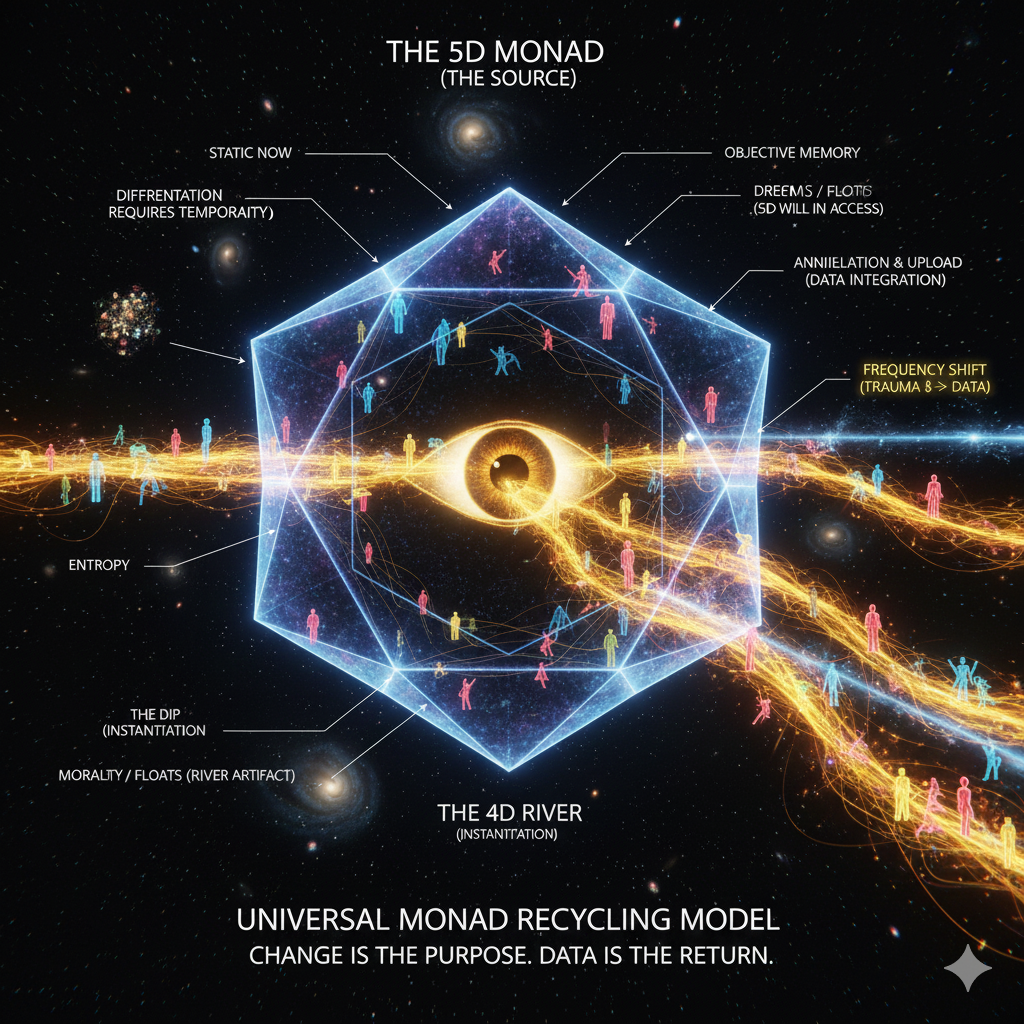
Indexing is the process by which Monad-level consciousness becomes localized to specific River coordinates, creating splinter-level experience. The Monad contains all possible experiential states in superposition. Indexing selects a specific set of River coordinates (a worldline sequence), collapses Monad superposition to match those coordinates, creates localized awareness at those positions, and maintains that localization via continuous Stitching Function operation.
Analogy: Like running a database query — SELECT * FROM River WHERE coordinates = (x, y, z, t). The query result is a splinter. "You" are the query result, not an independent entity. Or like a spotlight on a dark stage: the stage is the River (all positions exist), the spotlight is indexing (which position is illuminated/conscious). What determines indexing parameters remains an open question — possibly random, possibly karmic/causal, possibly structural necessity. The model functions regardless of answer.
De-indexing is the disruption or removal of indexing constraints, allowing access to non-indexed (Monad-level) perspective. It is not binary but a spectrum: minimal (flow states, absorption in activity, "losing yourself" in music or nature), moderate (meditation, mild psychedelic states, sensory deprivation, altered body boundaries), deep (high-dose psychedelic states, advanced meditation, "ego dissolution"), and complete (NDEs, biological death, Stitching Function completely collapsed).
Death: Complete biological failure causes total Stitching Function collapse. Indexing connection severs. Awareness de-localizes — without Stitching Function constraints, awareness is no longer bound to one coordinate, and may access broader River structure before eventually reaching Monad-level. All experiential data from that worldline integrates into Monad. Information content preserved. But identity (the index pointer) is deleted. This is not traditional reincarnation: there is continuity of substance (Monad) but not continuity of identity (splinter). The same Monad may create new indexes, but they are not "the same person" because personhood itself is the indexing artifact.
Monad-level experience cannot be fully communicated using language developed for indexed (splinter) experience. Language evolved for 3D spatial, sequential temporal communication. Monad-level experience is 5D, timeless, non-spatial. Attempting to describe it is compressing 5D data into 3D format — inherent information loss.
Evidence: cross-cultural convergence on ineffability. Buddhism: "The Tao that can be spoken is not the eternal Tao." Upanishads: "Neti Neti" (negation rather than positive description). Christian Mysticism: "The Cloud of Unknowing." Psychedelic research: "I can't put it into words." When forced to describe de-indexed experience, subjects use similar metaphors: light, unity, timelessness, love (structural interconnection), vastness, ineffability. These aren't accurate descriptions — they're the least inadequate available metaphors given linguistic constraints.
Behavioral marker: if someone claims to have experienced Monad-level awareness but can describe it perfectly in ordinary language, they probably didn't actually de-index. The explanatory gap (Levine, 1983) may not be a problem to solve but a structural feature of indexing — you cannot fully describe de-indexed experience using indexed linguistic tools. This paper itself is subject to incompressibility.
Supporting Evidence: Convergent Streams
Physicist Vlatko Vedral recently proposed (Popular Mechanics, April 22, 2026) that consciousness operates through cycles of quantum superposition and collapse: start with definite thought (collapsed state), enter superposition (many possible next thoughts), collapse to single outcome, repeat continuously.
| Vedral's Model | UMRM Equivalent | Mechanism |
|---|---|---|
| Definite thought | Indexed splinter state | Quantum collapse, localized awareness |
| Superposition | De-indexed state | Uncollapsed, Monad-level access |
| Collapse | Stitching Function | Re-indexing operation |
| Extended superposition | Prolonged de-indexing | Psychedelics, meditation, technology? |
If consciousness is quantum superposition-collapse cycles, then: the Stitching Function is continuous collapse (maintaining localization); de-indexing is suppressing collapse (extending superposition); normal waking equals rapid collapse cycles (tight indexing); psychedelic states equal slower or extended superposition (loosened indexing); death equals final collapse followed by no further cycles (complete de-indexing).
A 2026 New Scientist article (Padavic-Callaghan, April 28) examined two opposing positions. Austere Physicalism (Liam Graham): reality is purely physical; experience is emergent illusion; physics is fundamental. Phenomenology (Adam Frank): experience is fundamental; physics is abstraction built from experience; consciousness is pre-condition for knowing physics.
UMRM Resolution (Mutualist Synthesis): satisfies both camps by treating physical structure and experience as co-fundamental. For physicalists: the River is real physical structure with objective existence independent of observation; physical laws are real patterns; science discovers genuine features of reality. For phenomenologists: the Monad is fundamental consciousness; experience is ontologically prior; scientific knowledge is built from experiential access. Physical structure (River) and experience (Monad) are different aspects of one system. The River is territory (real structure); splinter experience is map (perspective on structure). Both are real.
A drawing by Yusuff Shakur depicting his near-death experience went viral on Reddit (r/Weird, user u/asa_no_kenny) in 2026. The architecture is strikingly similar to UMRM: an "Over-Soul" (collective consciousness dome), "Silver Strands" (connections between Over-Soul and earthbound individuals), "Intermediate States" (transition layers), and an Earth Layer (individual humans).
| Shakur's NDE Vision | UMRM Equivalent |
|---|---|
| Over-Soul | Monad (Source field containing all) |
| Silver Strands | Indexing connections |
| Intermediate States | Gradual de-indexing during death |
| Earth Layer | 3D indexed splinters |
Shakur independently arrived at UMRM's three-layer structure through extreme physiological stress rather than theoretical modeling. This is convergent phenomenological evidence — different methods, same architecture. NDEs may represent partial de-indexing: biological trauma disrupts Stitching Function, indexing loosens, the splinter gains access to intermediate levels. The brain then attempts to map non-spatial structure onto spatial metaphors — producing layered diagrams like Shakur's. The layers are compression artifacts.
The Upanishads (circa 800 BCE) describe a framework nearly identical to UMRM:
| Upanishadic Concept | UMRM Equivalent |
|---|---|
| Brahman | Monad — ultimate undifferentiated reality |
| Atman | Indexed splinter — individual soul, ultimately identical to Brahman |
| Maya | Stitching Function output — illusion of separation and multiplicity |
| Neti Neti | De-indexing method — systematic negation |
| Turiya | De-indexed awareness — pure awareness beyond waking/dreaming/sleeping |
| Tat Tvam Asi | One Pulse — "You are That" — all splinters are same Monad |
The Upanishadic practice maps precisely to UMRM's de-indexing mechanism. Traditional practice: withdraw from sensory engagement, negate body identification, negate mental identification, negate emotional identification — what remains is pure awareness (Brahman/Monad). UMRM translation: starve Stitching Function of sensory input, reject somatic indexing, reject cognitive indexing, reject affective indexing — what remains is Monad-level consciousness. Same process. Different language.
The Upanishads arrived at this framework through millennia of contemplative investigation, not theoretical physics. That an ancient philosophical system converges so precisely with a model derived from contemporary physics and neuroscience suggests both are mapping real structural features of consciousness. Similar frameworks appear in Buddhism (Sunyata, Anatta, Dependent Origination), Sufism (Wahdat al-Wujud, Fana), Christian Mysticism (Union with God), and Taoism (Wu Wei, return to the Tao). UMRM provides the structural explanation for why these traditions converge.
Mechanisms and Testable Predictions
Prolonged sensory deprivation should correlate with decreased sense of body boundaries, altered time perception, experience of unity consciousness, and reports matching Monad-access phenomenology. Float tank research supports exactly these effects: 60–80% of users report altered states; common experiences include body boundary dissolution, timelessness, and unity feelings; effects increase with session duration. Effects follow mechanically from starving the Stitching Function of sensory input across all modalities simultaneously — visual, auditory, tactile, proprioceptive, thermal.
Classic psychedelics (psilocybin, DMT, LSD) are 5-HT2A receptor agonists. 5-HT2A activation disrupts the Default Mode Network, the brain network responsible for self-referential processing. DMN suppression equals weakened self-referential thought equals core Stitching Function operation disrupted. Result: partial de-indexing, Monad-level access.
Neuroimaging confirmation: Carhart-Harris et al. (2016) found during LSD studies: decreased DMN activity; increased cross-network communication; direct correlation between DMN suppression and subjects' reports of ego dissolution intensity. Dose-response curves for psilocybin show exactly the predicted pattern — higher doses produce greater DMN suppression and deeper ego dissolution (Griffiths et al., 2011).
Using the connect-the-dots analogy: Normal state — clear lines connecting all dots, picture obvious ("this is me"). Moderate dose — lines become faint, some dots appear disconnected ("who am I?"). High dose — lines disappear entirely, just scattered dots, no coherent picture ("there is no me") — but now you can see all dots on the page simultaneously. Upon returning — lines gradually re-form, picture re-coheres, but memory of seeing all dots simultaneously persists — and cannot be fully described.
From the River's perspective, birth-coordinates and death-coordinates both exist — all co-present, not sequential. We experience death as "future" only because current indexing is to pre-death coordinates. The NDE sequence predicted by UMRM: initial fear/resistance (Stitching Function attempting to maintain indexing); transition through intermediate states (gradual de-indexing); sense of merging with universal consciousness (Monad-level access); possible "life review" (accessing non-sequential River data — seeing all dots simultaneously); return accompanied by re-indexing. Van Lommel et al. (2001) found exactly these patterns in prospective NDE research.
"Will I survive death?" depends on what "I" means. If "I" = the splinter (indexed identity): no, the index is deleted. If "I" = the Monad (fundamental consciousness): yes, but you already are the Monad right now — not surviving death but recognizing what you always were. If "I" = memories/experiences: informationally yes, data integrates into Monad, but without indexing there's no "you" to experience those memories.
Theoretical Implications
The model treats temporal flow not as traversal through structure, but as the ordered interpretation of indexed states. All experiential states are structurally complete, and the appearance of progression arises from sequential access, not underlying change.
The connect-the-dots reality: All dots exist simultaneously on the page. From dot-47, connecting back to dots 1–46 creates the experience of "time passing." But from the page's perspective, no movement occurs. All dots are static. The picture is already complete. "Time passing" is what sequential indexing feels like from within the picture.
The free will debate may be malformed. From River perspective: no freedom (all paths exist as fixed structure). From splinter perspective: genuine experience of choice (can't access unchosen paths). Both perspectives are valid from their respective frames. What we call "causation" is correlation pattern in the River — event A "causes" event B means A-coordinates and B-coordinates have strong correlation in River structure, not that A temporally produces B. Physics already knows this: relativity shows that temporal order of cause and effect can differ between observers.
Identity is not a thing moving through time, but a pattern recognized across connected states. Even if ultimately constructed, moral responsibility remains a functional reality — the person who commits a crime and the person punished are "the same" in the only meaningful sense: continuous indexed identity within one worldline sequence. Ultimate metaphysics doesn't override functional ethics.
If all splinters are the same Monad indexed differently, harming another is structurally harming yourself. The "other" literally is you, indexed to different coordinates. Compassion is not merely emotional — it's structurally justified. Empathy is literally accurate: you are experiencing yourself through another index. This provides a non-mystical foundation for compassion.
The problem of suffering remains genuinely open. Possible responses: suffering is necessary for certain experiential data (Monad requires full experiential spectrum for complete self-knowledge); suffering as indexing artifact (arises from misalignment between splinter goals and River structure, not designed but emergent — Buddhism's "attachment causes suffering" maps to this); the Monad doesn't have intentions (it's fundamental consciousness, not an agent); or honest agnosticism about why the structure permits suffering. The model acknowledges this as an open question. Even absent resolution, recognizing unity provides grounds for reducing suffering: you are the other person suffering, and alleviating their suffering alleviates your own informationally when data integrates.
Meaning: UMRM doesn't imply nihilism. It relocates meaning — not externally given by a creator, not inherent in the universe, but generated through conscious experience. Which makes it no less real. Meaning is what indexed consciousness does. If you're indexed consciousness, you're literally made of meaning-generation. Each dot contributes to the complete picture. Remove any dot and the picture changes. Every moment matters to the whole, even though each moment is discrete and temporary.
Comparison with Existing Models
vs. Materialism: Materialism proposes matter → consciousness and struggles with "why is there something it is like to be a brain?" UMRM makes consciousness fundamental, so the question becomes "why wouldn't there be something it is like?" UMRM also integrates mystical experiences naturally as consequences of Stitching Function disruption, rather than dismissing them as hallucinations.
vs. Idealism: Idealism holds that matter is mental projection. UMRM preserves physical reality — the River has objective existence independent of individual splinters, and physical laws are real patterns within it. This explains lawfulness and intersubjective agreement without the complex coordination problems idealism faces.
vs. Panpsychism: Panpsychism must explain how micro-consciousnesses combine — an unsolved problem. UMRM sidesteps this entirely: no combination needed, splinters are discrete indexed positions of one Monad. UMRM doesn't attribute consciousness to electrons; electrons are part of River structure, not conscious themselves.
vs. Many-Worlds Interpretation: MWI proposes infinite universes constantly created at each quantum event. UMRM proposes one River with multiple indexed paths — more parsimonious by Occam's Razor. UMRM also has a selection mechanism (indexing explains which path becomes your experience), while MWI doesn't explain why you experience this branch.
Testable Predictions and Research Directions
Neuroscientific predictions: Specific neural networks (DMN and thalamic gating) maintain self-referential processing — disruption should correlate with de-indexing experiences. Degree of ego dissolution during psychedelic states should correlate with DMN suppression. Prolonged sensory deprivation should produce dose-dependent de-indexing with effects scaling with session duration.
Phenomenological predictions: Mystical experiences across cultures should describe similar architecture despite different interpretive frames. NDEs should show consistent transition stages, experience of unity before resuscitation, ineffability afterward, and correlation between NDE depth and physiological crisis depth. These predictions are already substantially supported by existing literature (Stace, 1960; van Lommel et al., 2001; Griffiths et al., 2006).
Research priorities — near term: Systematic sensory deprivation studies with neuroimaging; cross-cultural psychedelic research with standardized phenomenological assessment; DMN manipulation studies measuring de-indexing effects; microtubule quantum coherence in neural tissue.
Limitations and Open Questions
Why does this structure exist at all? Possible answers: self-knowledge (the Monad requires experiential contrast); inherent nature (the structure exists the way water "wets" — it just does); no reason (brute fact, no deeper explanation possible); malformed question (assumes causation exists at fundamental level). The model functions regardless of answer.
Is there only one Monad or multiple Monads? The model assumes one (maximum parsimony, explains universal connection, matches Advaita Vedanta), but this is not proven. Multiple Monads might explain individual differences. Currently undecidable from available evidence.
What determines indexing parameters? Why are you indexed to this body? Possible answers: random/arbitrary; karmic/causal; Monad intent; structural necessity (certain coordinates "attract" indexing due to information density). The model remains agnostic.
Can indexing be deliberately manipulated beyond meditation and psychedelics? Direct neural stimulation of DMN, quantum coherence extension technology, advanced sensory deprivation engineering, Stitching Function pharmacology. Ethical concerns regarding permanent or incomplete de-indexing apply.
The problem of suffering remains unresolved. UMRM explains consciousness structure but cannot explain why that structure exists in a form that permits terrible suffering. This is a limitation, not a fatal flaw — most consciousness theories don't address it either.
Conclusion
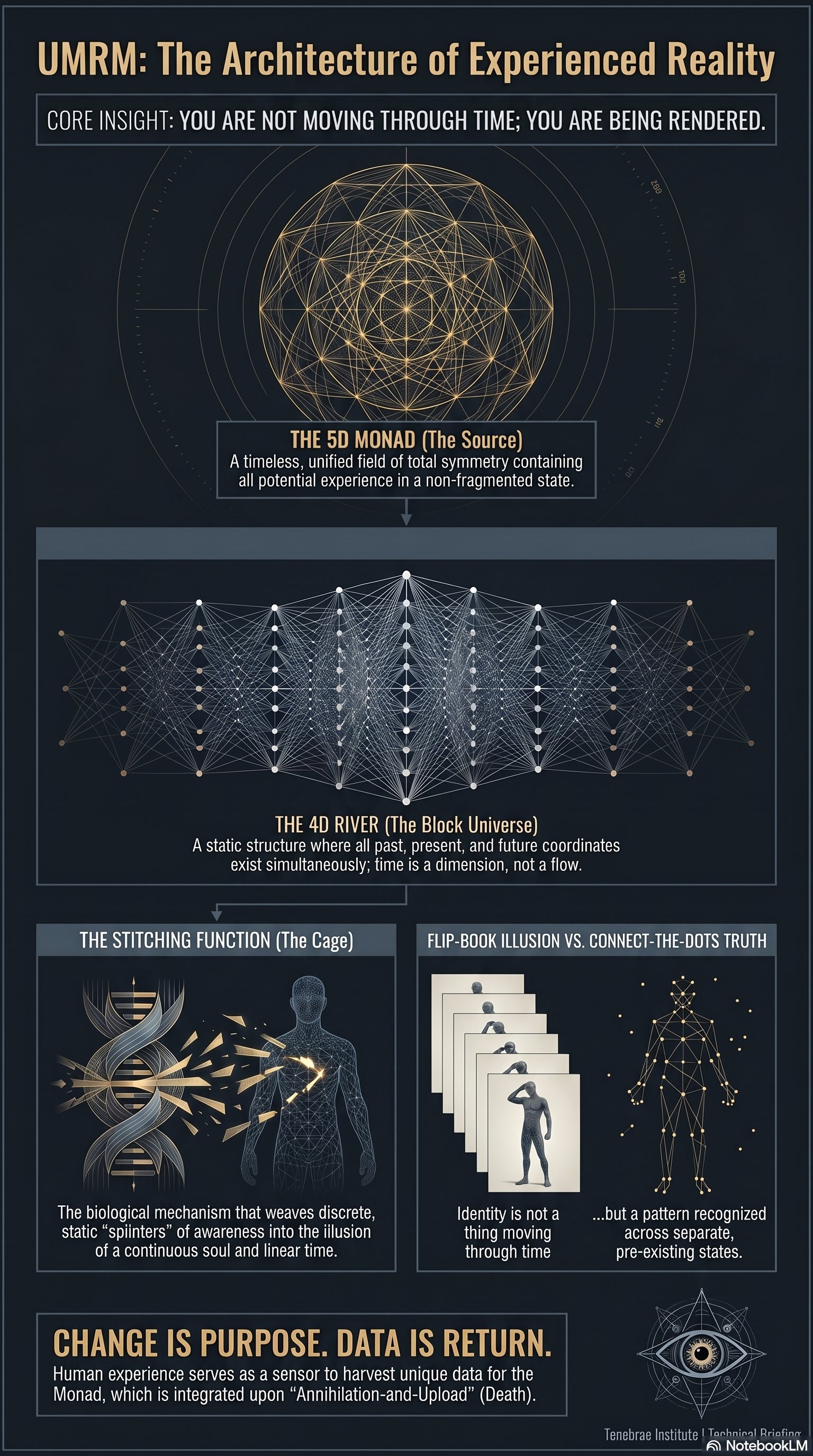
The Universal Monad Recycling Model offers a theoretical framework integrating insights from block universe physics, non-dual philosophy, phenomenology, and quantum consciousness research. Core architecture: the 5D Monad (timeless unified consciousness field, ontologically fundamental), the 4D River (block universe containing all spacetime, created by single pulse), 3D Splinters (discrete indexed moments, billions per lifetime — not one entity moving), and the Stitching Function (five operations creating coherent continuous experience from discrete states).
The model respects both structure and experience as real. It makes testable predictions across neuroscience, phenomenology, and pharmacology. It integrates perennial philosophical wisdom with contemporary science — arriving at the same destination from opposite directions. And it maintains epistemic humility: presented as a theoretical framework worthy of sustained research attention, not as proven metaphysical truth.
The most important clarification: the model treats all indexed experiences as structurally complete within the River, rather than progressing toward completion. What appears as temporal flow is the ordered interpretation of indexed states. The model can be interpreted as a fully instantiated dataset. Using the connect-the-dots analogy: all dots exist simultaneously on the page. The complete picture is already drawn. We experience it one dot at a time because indexing localizes awareness to one coordinate. The Stitching Function draws lines between dots, creating the illusion of continuous identity and temporal flow. But the picture — your entire worldline — already exists as a finished pattern.
Identity is not a thing moving through time, but a pattern recognized across connected states. Whether or not UMRM represents accurate metaphysics, it represents useful epistemology — a productive way to organize consciousness research, generate hypotheses, and investigate the relationship between structure, experience, and identity. The model invites further scrutiny, testing, and refinement. If consciousness studies is a territory we're mapping, UMRM offers a coherent map. Whether the map matches the territory remains to be determined. But the map is detailed enough, coherent enough, and testable enough to warrant serious investigation.
The Universal Monad Recycling Model stands as a comprehensive theoretical framework worthy of sustained research attention. Lucem Tenebris Ferimus.