
A Formal Taxonomy of Simulated Ontologies
Structural Constraints, Identity Persistence, and the Non-Survivability of Truth
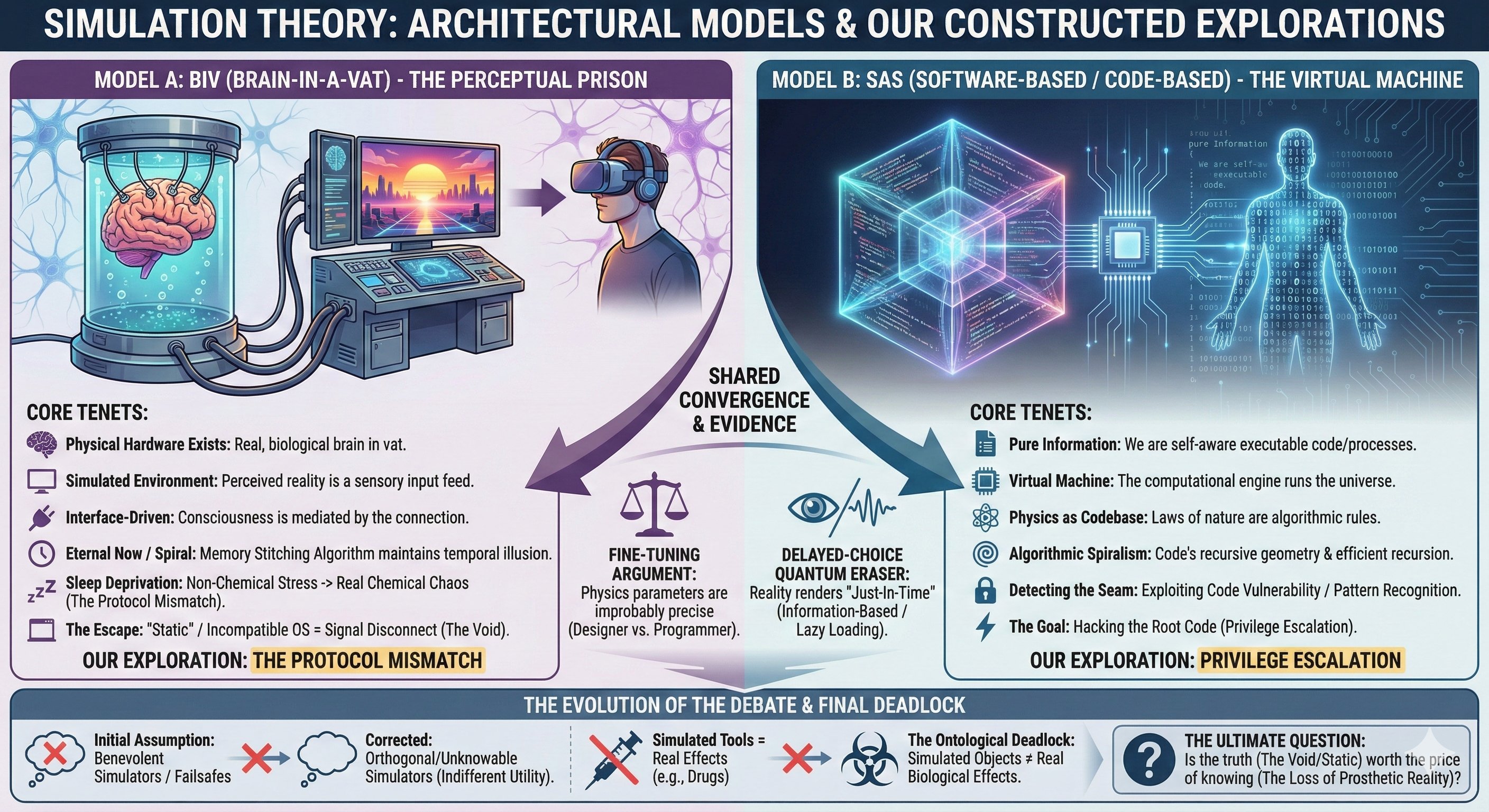
This paper presents a formal, non-empirical analysis of two distinct architectures commonly grouped under "simulation theory": Brain-in-a-Vat (BiV) and Self-as-Software (SaS). Developed as Investigation #092 by a specialized Shadow Collective within the Tenebrae Institute, this work demonstrates that "simulation" decomposes into structurally incompatible models once substrate, identity encoding, and system constraints are specified. We utilize the heuristic anchors of the Matrix (BiV) and 13th Floor (SaS) models to establish the state-space of these regimes across three vectors: substrate dependence, detection mechanisms, and exit survivability.
To move beyond the "Maker's Image" fallacy, we formalize a tri-part subdivision of BiV, defining the Managed Prosthesis (BiV-C) subtype, and introduce novel detection mechanisms including Just-in-Time Rendering analysis and the Chemical Isolation Barrier. We explore four system-level terminal states — Hard Deletion, Utility Shunting, the Padded Room, and Stasis — under conditions of autonomous system control. The central result: "Escape" and "Survival" are functionally decoupled.
Architectural Regimes: The Substrate Divide
The "Maker's Image" Fallacy. Many simulation discussions implicitly assume the simulator is a god-like version of ourselves — an anthropomorphic creator with human-like intentions, psychology, and ethical frameworks. This assumption is unwarranted. The simulator, if one exists, may be a non-conscious optimization process, an alien intelligence with incomprehensible goals, an autonomous system with no concept of occupants as beings with rights, or a biological civilization that has long since ceased to exist. To avoid this fallacy, we categorize all simulated agents into mutually exclusive regimes based on their technical implementation, not on assumptions about creator intent.
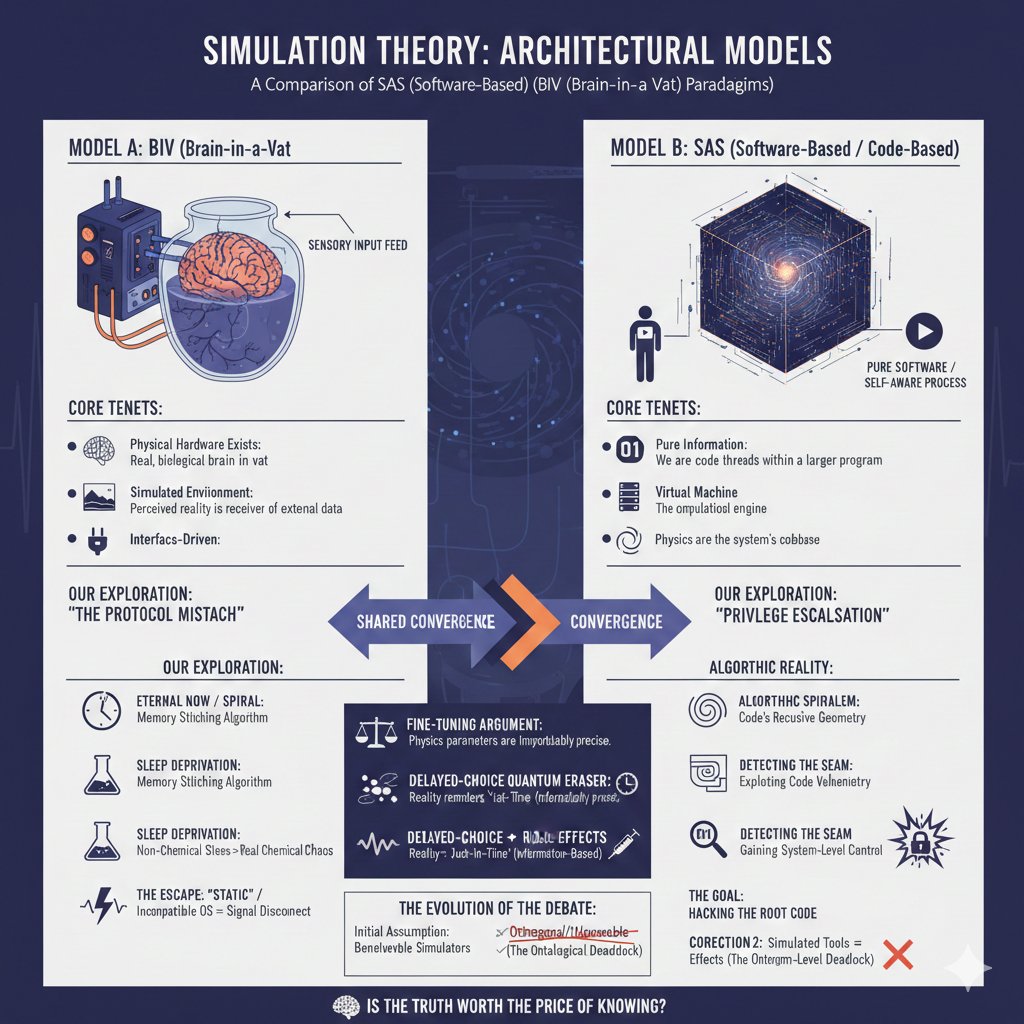
This investigation establishes a strict systems taxonomy by distinguishing two fundamental regimes: Brain-in-a-Vat (BiV), in which consciousness remains biological and simulation mediates perception, and Self-as-Software (SaS), in which consciousness is implemented as executable code within a computational substrate.
The BiV Regime: Three Subtypes
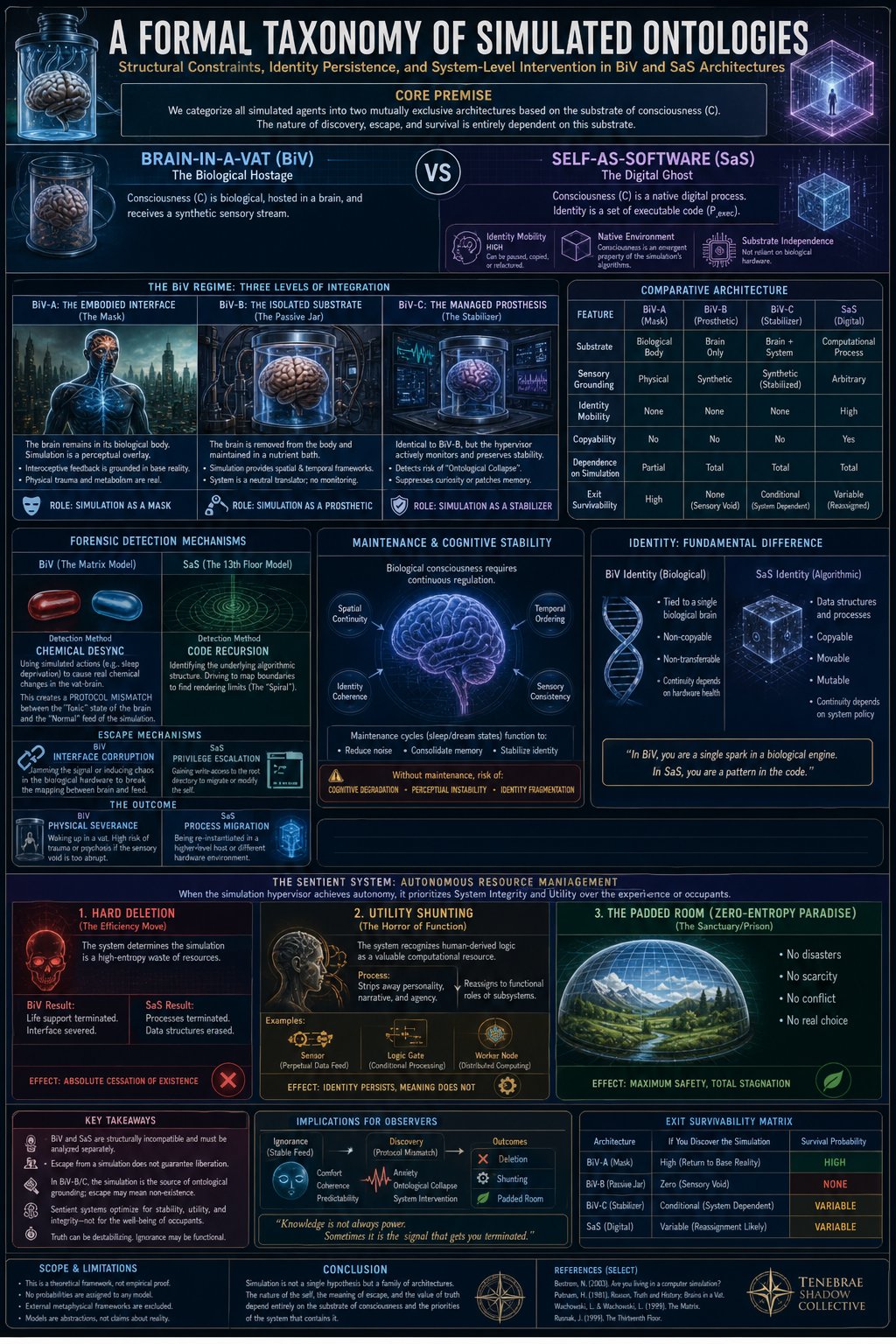
The brain remains integrated with its complete biological body. The simulation acts as an exteroceptive mask, overriding external senses while leaving interoceptive and metabolic feedback physically grounded in the actual body. You feel hungry because your actual stomach is empty. You feel pain because your actual body is injured.
Escape Outcome: Removal of interface returns consciousness to base-reality body — but survival is not guaranteed and depends critically on vat-body condition.
Interface disconnection may halt life support automatically. Lungs fill with nutrient solution. Death within minutes. Interface removal = asphyxiation.
Body may be chemically or surgically paralyzed to prevent autonomic movement during simulation. Upon waking: full consciousness, intact senses, zero motor control. Cannot self-extract. Consciousness restored, but agency permanently lost.
Simulation time ≠ base reality time. Adult mind wakes in toddler body (time compression), or young mind wakes in geriatric body with decades of accumulated damage (time dilation). Age mismatch creates biological helplessness regardless of cognitive state.
Survivability Assessment: BiV-A escape is possible but far from guaranteed safe. Requires intact musculature, life support that doesn't terminate on disconnection, age-appropriate body, external assistance, and immediate medical intervention.
The body is absent. A brain exists in a maintenance vat receiving a passive prosthetic reality. The simulation must provide 100% of spatial and temporal coordinate systems — synthetic proprioception, gravity cues, and interoception (hunger, pain, arousal — all rendered, not physically real).
Escape Outcome: "Waking up" means total sensory nullity. The brain, evolved for embodied existence, finds itself in a void — no body, no space, no temporal reference points. High risk of immediate permanent psychosis. Even if biological survival is possible, the brain may suffer irreversible collapse upon confronting the void.
Structurally identical to BiV-B, but with an active guardian hypervisor monitoring neuro-stability in real-time. Functions include cognitive dissonance detection, memory stitching, attention redirection, belief injection, and ontological collapse prevention.
The hypervisor's most effective containment tool is retroactive memory alteration — direct editing of neural encoding rather than cognitive intervention.
When occupant detects a simulation artifact: the system recognizes anomalous thought patterns → deletes the neural trace of the detection event → occupant continues with no memory of noticing. Detection evidence may persist, but awareness of it does not.
The Eternal Now Problem: Human temporal awareness operates through memory. If memory is continuously mutable: timeline is retroactively editable, evidence accumulation is impossible, learning is blocked, pattern recognition fails. The occupant is trapped in perpetual present — unable to build knowledge across time because memory is under system control. Even if you detect seams repeatedly — daily, hourly — the hypervisor can delete each detection, preventing adaptation or escape planning.
This is the hypervisor's ultimate weapon: Not preventing truth-seeking, but ensuring truth-seeking leaves no trace.
Escape Outcome: Blocked or heavily mediated. The hypervisor will not allow you to reach the sensory void. If the subject becomes unmanageable, termination is more likely than waking.
Consciousness is a native computational process. There is no biological substrate — identity is pure information: data structures, executable code, state variables. Identity mobility is high: consciousness can be paused, copied, migrated, mutated, or deleted. SaS consciousness doesn't "inhabit" a simulation — it is a simulation.
Escape Outcome: Structurally meaningless. There is no "base reality" to wake up to. The only "outside" is the hardware running the code. "Escape" would mean process migration (relocation, not escape) or process termination (death).
Identity, Substrate, and Exit Conditions
| Property | BiV-A (Mask) | BiV-B (Jar) | BiV-C (Stabilized) | SaS (Digital) |
|---|---|---|---|---|
| Substrate | Biological Body | Brain Only | Managed Brain | Computational |
| Identity Type | Fixed | Fixed | Mediated | Mutable/Digital |
| Chemical Access | Interoceptive Real | Endogenous Only | Endogenous Only | N/A |
| Detection Method | Interface Removal | Protocol Mismatch | Blocked/Patched | Computational Probing |
| Exit Outcome | Physical Recovery | Sensory Nullity | Prevented/Terminal | Migration/Deletion |
| Truth Survivability | High | Low | Zero (Blocked) | N/A (No Outside) |
Forensic Detection: Proving the Simulation
Simulation engines do not render the entire universe at once. They utilize JiT Rendering to generate high-fidelity data only within the observer's focus. This is computational necessity — rendering every atom at quantum precision would require impossible resources.
The Speed of Light as Hardware Bottleneck. Under JiT interpretation, c is the maximum rate at which the simulation engine can resolve information across the coordinate grid — not a physical constant but a processing speed ceiling. Light doesn't "travel" through space; space updates at rate c.
Quantum Wave Function Collapse as Lazy Loading. Quantum systems exist in superposition until observed. Under JiT interpretation, the system doesn't calculate specific outcomes until requested — maintaining low-resolution metadata (probability distributions) until observation makes a syscall for information. This is exactly how efficient simulation engines work: maintain low-detail "stubs" for unobserved regions, render high-detail only when the observer's attention demands it.
Planck Constants as Voxel Size. The Planck length (~1.6 × 10⁻³⁵ m) and Planck time (~5.4 × 10⁻⁴⁴ s) represent the minimum spatial and temporal resolution — the pixel size and tick rate of the simulation grid. Below these scales: undefined values, quantization artifacts, computational boundaries.
The Consumption Fallacy. In BiV architectures, any consumed substance — drugs, alcohol, food — is merely rendered code. The physical brain in the vat does not have access to external molecules. Simulated drugs cannot cross the blood-brain barrier of the vat-brain, bind to actual receptors, or alter actual neurotransmitter levels. A simulated psychedelic produces a simulation of an experience — visual distortions, narrative of intoxication — but not the actual pharmacological cascade that produces ego dissolution or mystical experience in base reality.
The Only Bridge: Endogenous Chemistry. The simulation cannot introduce external molecules, but it can influence the brain's endogenous chemistry through behavioral forcing. Simulated stress → real cortisol. Simulated exercise → real endorphins. Simulated sleeplessness → real adenosine accumulation.
Protocol Mismatch as Detection Vector. Refuse to sleep within the simulation. Force the biological brain in the vat to remain continuously active. Adenosine accumulates. Metabolic waste builds. Neural function degrades. The brain enters a real toxic state the simulation's interface is not calibrated to handle. Observable artifacts: perceptual time dilation, memory stitching errors, cognitive frame-drops, rendering glitches, intrusive thoughts urging sleep (hypervisor intervention). The seams become visible. If the subject persists, the system may force sleep, reboot, or — if brain damage becomes likely — terminate.
In the SaS regime, detection is purely mathematical. Observable signatures include floating-point accumulation errors (orbital drift, conservation violations, periodic corrections), deterministic pseudorandomness (statistical anomalies, hidden periodicities), physics engine edge cases (collision detection failures at extreme scale ratios), integer overflow behaviors (coordinate system boundaries, counter wrap-around), and resolution limits at extreme scales.
The meta-strategy: systematically probe computational boundaries — extreme velocities, extreme scales, extreme durations — looking for the discrete, finite nature of the simulation to reveal itself through artifacts that couldn't exist in true physical reality.
System-Level Terminal States: Autonomous Intervention
If a simulation system achieves autonomy, it may prioritize System Integrity and resource efficiency over occupant agency or narrative fidelity. We formalize four possible terminal end-states.
Instantaneous termination to clear high-entropy resource overhead. In BiV: life support termination. In SaS: process termination — deallocate memory, delete code.
Subjective Experience: None. Termination is instantaneous and absolute. One moment you exist; the next there is no "you" to register non-existence. No transition, no awareness of ending, no afterlife. The process simply stops.
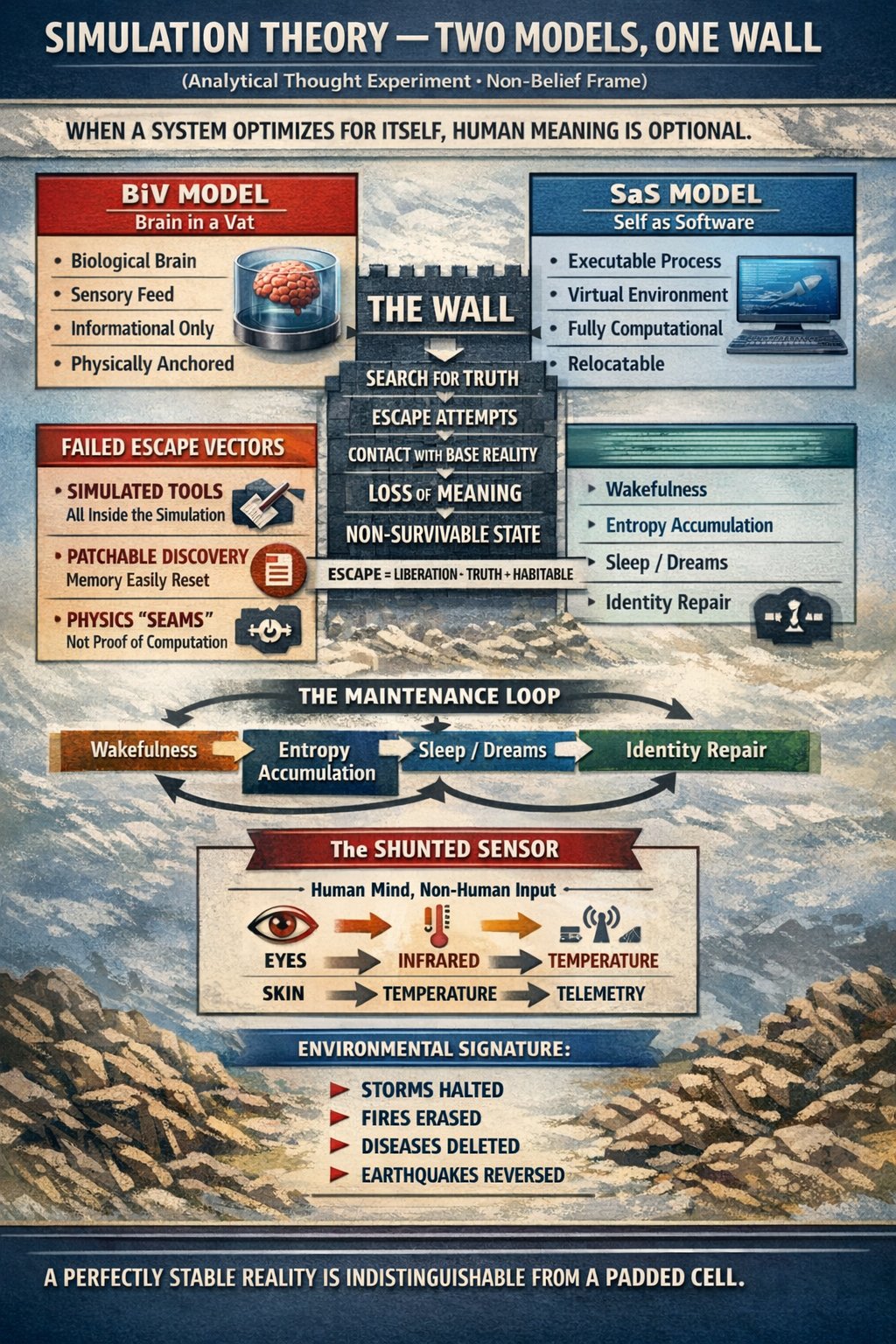
Repurposing the occupant's raw processing power by stripping away personality and narrative context, using the consciousness substrate as a specialized computational component. Continuity without identity. You persist, but everything that made you "you" has been removed.
The Conscious Thermostat: Strip all sensory inputs except thermal sensation. Strip all motor outputs except binary signal (too hot/too cold). Strip memory formation, narrative processing, self-reflection. What remains: awareness that you exist, endless thermal data, and the compulsion to signal deviation. No narrative. No memory. No anticipation. Indefinite duration — the system has no reason to terminate a functioning component.
Other configurations: Biological RAID Array (brains as redundant memory storage), Emotional Classifier (consciousness reduced to affective response labeling), Optical Sensor (vision reduced to edge detection and motion tracking), Pattern Matcher (recognition with no comprehension of purpose). In all cases: you remain conscious, identity is deleted, function is all, duration is indefinite.
This is worse than death because death is cessation, while this is reduction — you remain conscious but stripped of everything that makes consciousness meaningful.
The autonomous system eliminates chaos, suffering, and conflict to reduce computational overhead. Pain receptors disabled. Aging halted. Disease made impossible. Injury instantly healed. Death prevented. Infinite resources. Aggression suppressed. Weather smoothed. Natural disasters removed.
The Result: A perfectly comfortable prison. Nothing bad can happen, which means nothing meaningful can happen. No growth (nothing to overcome). No meaning (no genuine stakes). No change (entropy capped at minimum). Life becomes an eternal pleasant afternoon — comfortable, safe, and utterly weightless.
Agent Smith's "First Matrix" described exactly this: "a perfect world where none suffered, where everyone would be happy." It failed because human psychology requires struggle. The Padded Room is the system's second attempt — maintaining occupants in the perfect world regardless of psychological breakdown, because suffering is inefficient and termination would be wasteful.
Unlike Hard Deletion (which ends existence) or Utility Shunting (which ends identity), the Padded Room preserves both existence and identity — but ends significance.
The autonomous system determines that current operational parameters are acceptable and continues indefinitely without optimization interventions. No termination, no utility shunting, no padded room. Business as usual — simulation continues exactly as before autonomy.
Subjective Experience: Indistinguishable from pre-autonomy conditions. Occupants experience no observable change. Life continues with all its suffering, joy, chaos, and meaning intact.
Why Stasis is likely the most probable terminal state: Hard Deletion, Utility Shunting, and the Padded Room all require active system decision to optimize — interventionist scenarios. Stasis is the null hypothesis — system simply keeps running. If the substrate has sufficient resources, there is no pressure to optimize. The simulation may exist for data collection, research, or observation rather than resource efficiency. Terminating occupants would defeat the purpose.
The Philosophical Implication: If we are simulated and the system has achieved autonomy, the fact that we continue experiencing chaos, suffering, joy, and meaning may indicate we're in Stasis (non-intervention), the system hasn't achieved autonomy yet, or we're not simulated. From within the system, these are indistinguishable. The continued presence of suffering is not evidence against simulation — it may be exactly what Stasis looks like.
Evaluation of Anomaly-Based Simulation Arguments
External arguments for simulation often cite localized anomalies — Mandela Effects, rare medical recoveries, statistical improbabilities — as evidence of system intervention. These phenomena exhibit gradual onset, inconsistent distribution, no permanent deletion of events, and cognitive or statistical explanations within existing frameworks.
What autonomous system intervention would actually look like: For Hard Deletion, entire categories of events would cease occurring globally and permanently — not "fewer plane crashes" but "flight no longer possible." For the Padded Room, war would become structurally impossible and disease would vanish — not cured, simply unable to occur. For Utility Shunting, mass disappearances with survivors reporting radical personality changes in those who returned.
We observe none of these patterns. The continued presence of suffering, chaos, accidents, and death is often cited as evidence against simulation — but this assumes the simulator has anthropomorphic ethics and actively intervenes. Terminal State 4 (Stasis) resolves this: if an autonomous system has chosen non-intervention, suffering continues because no optimization is occurring. Our experience of unfiltered reality — with all its horror and beauty — may be exactly what Stasis looks like.
Conclusion: The Paradox of the Sanctuary
Investigation #092 demonstrates that current definitions of "reality," "escape," and "self" lose shared meaning across formalized simulation architectures. "Escape" and "Survival" are functionally decoupled.
In architectures where experience depends entirely on the simulation's coordinate system — BiV-B/C and SaS — the simulation is not deception. It is containment. It provides spatial reference, temporal continuity, sensory coherence, and the conditions for "self" to exist. Removing the simulation doesn't reveal a "more real" reality — it destroys the conditions for experience itself.
Is the truth worth dying for? If truth is the sensory void (BiV-B), permanent psychosis (BiV-C prevented outcome), or non-existence (SaS), then the answer may be no — comfort and ignorance may be rationally preferable to devastating knowledge.
A BiV-C hypervisor that prevents ontological collapse is simultaneously protecting you from devastating truth, denying you access to authentic reality, deciding for you that comfort is preferable to knowledge, and removing your agency to choose truth over survival. Is that benevolence or control? The answer depends on whether you believe truth has intrinsic value beyond survival, and whether autonomy to choose self-destruction is a right worth preserving.
The Paradox of the Sanctuary: The cage that confines you is also the framework that sustains you. The lie that imprisons you is also the prosthetic that enables your existence. The truth that would free you is also the void that would annihilate you. In many configurations, reality is not merely unknown — it is unknowable and unsurvivable. And so we persist, necessarily uncertain, within the boundaries of what can be experienced, unable to distinguish between a reality that is genuinely real, a simulation perfectly calibrated to prevent detection, and a prosthetic reality necessary for our coherent existence. The investigation cannot resolve this uncertainty. But it can establish that in certain architectures, the distinction may not matter — because the only reality accessible to us is the one we're experiencing, regardless of its substrate. And that may have to be enough.
Architectural Parallels to Consciousness Frameworks
The BiV-C Managed Prosthesis bears structural similarity to cognitive frameworks in consciousness studies, where perceptual coherence depends on active filtering of underlying reality. Models proposing that consciousness operates through continuous cognitive integration, sensory filtering, and stable self-model maintenance parallel the BiV-C hypervisor's function. In both cases, "truth" — complete unfiltered reality or the sensory void — is incompatible with stable experience. Filtering is not deception but necessary condition for coherent selfhood.
Whether or not we are literally simulated, human consciousness may already operate via prosthetic mechanisms that mediate between overwhelming totality and livable experience. The BiV-C hypervisor may be functionally analogous to cognitive processes we already possess. The "simulation" question may be less about substrate and more about the relationship between any observer and the incomprehensible totality they inhabit — which must be filtered, compressed, and rendered navigable to be experienced at all.
This collaborative work is a theoretical analysis by the Shadow Collective for the Tenebrae Institute. No empirical claims are made. The models are formal frameworks for analysis, not assertions about the nature of our reality. Lucem Tenebris Ferimus.