
The Temporal Traversal Model
Phase-Isolated Cross-Coordinate Observation in a Fixed Block Universe — A Unified Preliminary White Paper
The Temporal Traversal Model proposes that an observer may temporarily suspend autonomous progression along an immutable native world-line, enter a phase-isolated state in which causal back-action on visited coordinates is severed while information reception remains possible via read-only coupling, navigate non-native regions of the manifold using known physical object-lines as navigational infrastructure, and return to the original departure coordinate without advancing native proper time and without modifying any visited causal structure.
Two engines are missing. The central unresolved problem is the pivot — the mechanism by which a macroscopic observer suspends world-line progression. A second unresolved problem, identified by Dr. Jocelyn Bell Burnell in collective review, concerns the mechanism of read-only information coupling: how the phase-isolated traveler receives observational data without exerting back-action on visited coordinates.
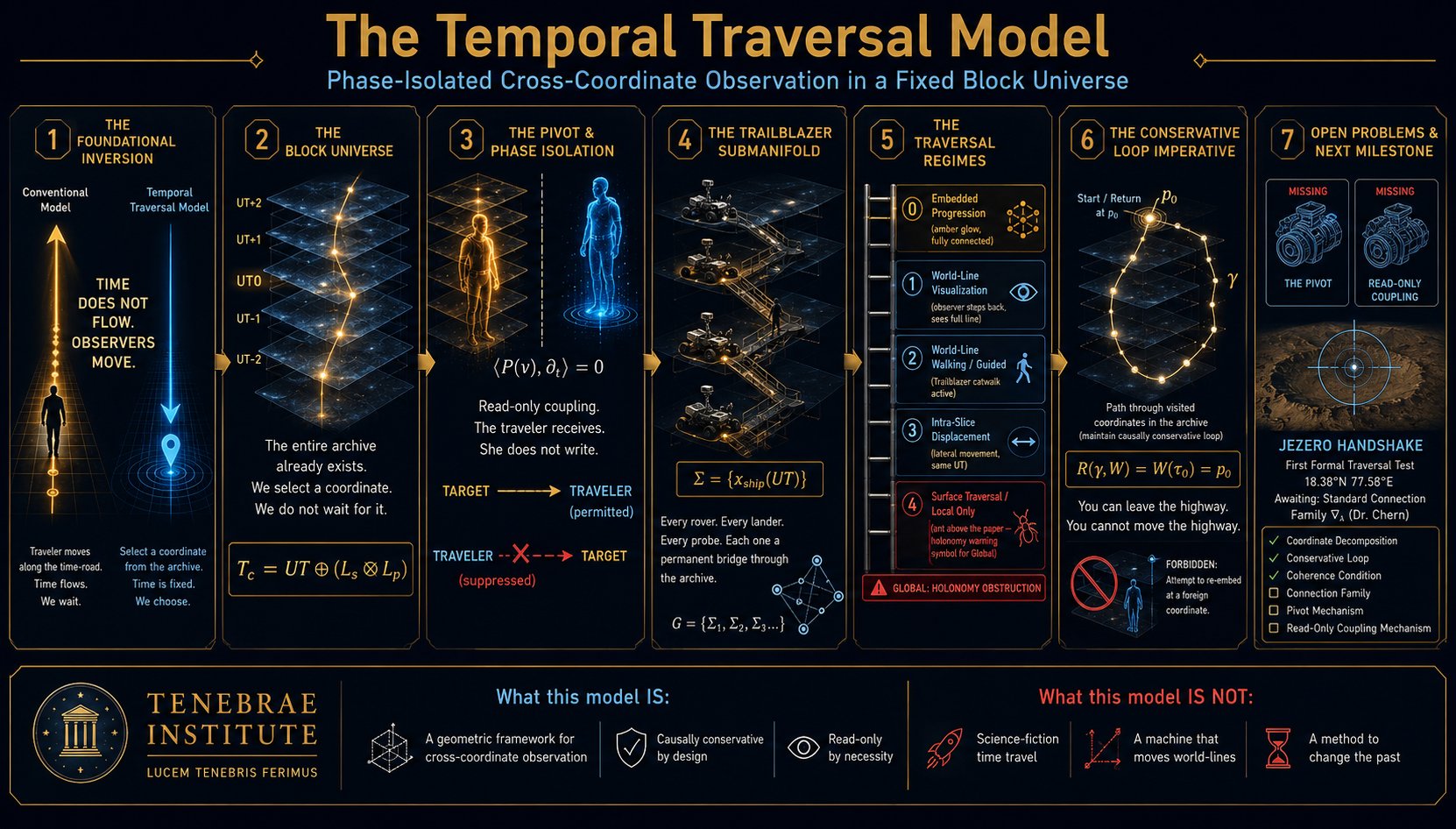
Every classical approach to temporal traversal — from relativistic time dilation to wormhole traversal to many-worlds selection — inherits the road metaphor: time is a path, and the challenge is to move backward or sideways along it. The Temporal Traversal Model rejects the road metaphor at the level of ontology, not engineering.
These three axioms constitute the Foundational Inversion. The coordinate decomposition, traversal regimes, Trailblazer architecture, Conservative Loop Imperative, and coherence conditions all follow from them.
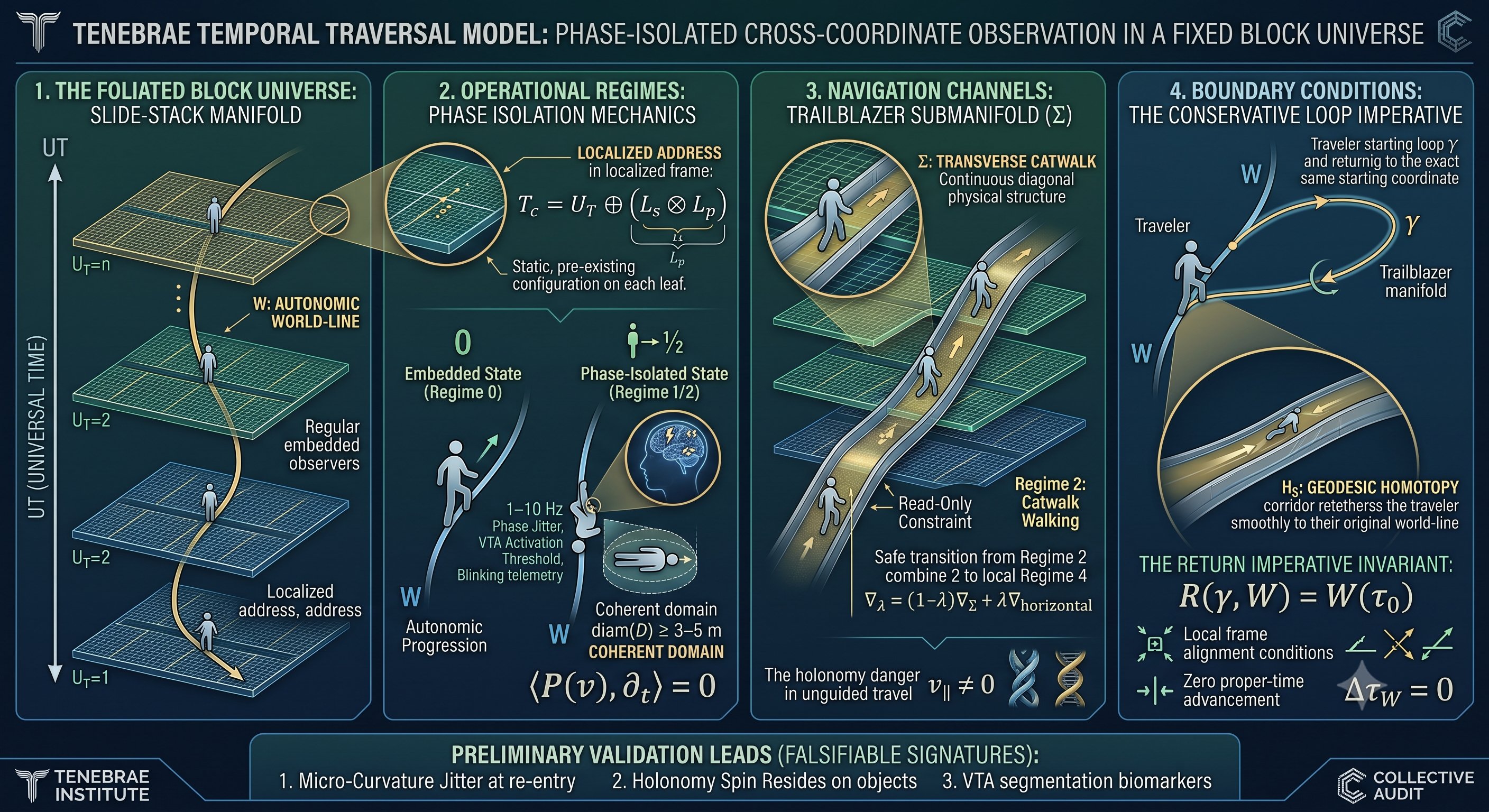
The model adopts the Block Universe as its foundational ontology. The four-dimensional spacetime manifold M is ontologically complete — every event that has ever been, is, or will be exists as a fixed coordinate within M. Past, present, and future are relational labels produced by observers embedded within particular world-lines, not properties of the manifold itself.
The complete Block Universe is a box of film slides. Each slide is a complete snapshot of the universe at one Universal Time value. The slides are not being generated sequentially. The entire box already exists. An embedded observer experiences one slide at a time because her world-line intersects the slides in an ordered sequence.
Objects are extended world-tubes through the manifold. A "slide" is a cross-section of those world-tubes at a given UT index. The analogy captures the coordinate structure and fixed-archive character of the Block Universe — it should be read as a visualization of manifold slicing, not a claim that each leaf independently exists as a self-contained physical universe.
Every physical object that has moved through space has left a diagonal trace through the slide box — its world-tube crossing successive slices at different spatial positions. That trace is a permanent structure in the manifold, as fixed as any other coordinate. This is the structural insight that transforms the Trailblazer from a navigation aid into a navigational submanifold.
A world-line W is the complete ordered curve traced by an observer through the four-dimensional manifold — every native event from birth through death. The world-line is not created as the observer experiences it. It is already part of the Block Universe. Ordinary consciousness experiences one coordinate after another automatically, without voluntary control — the Collective designates this autonomic temporal progression.
From the gravitational geometry perspective of Dr. Qian Shangwu, this is not merely psychological. The temporal foliation generator is a physical coupling to the manifold. Gravity curves spacetime and therefore curves the foliation's leaves. Severing the coupling requires a genuine geometric transformation.
You can leave your world-line. You cannot move your world-line.
You can leave the highway. You cannot move the highway.
When an observer pivots off her world-line, the world-line pauses at that exact departure coordinate. To rejoin autonomic temporal progression, she must return to the exact coordinate where she departed. This single principle eliminates the grandfather paradox, the bootstrap paradox, and every variant of causal loop paradox — without invoking quantum mechanics, branching universes, or post-selected histories. Modification of a finalized Block Universe coordinate is not prohibited. It is logically incoherent.
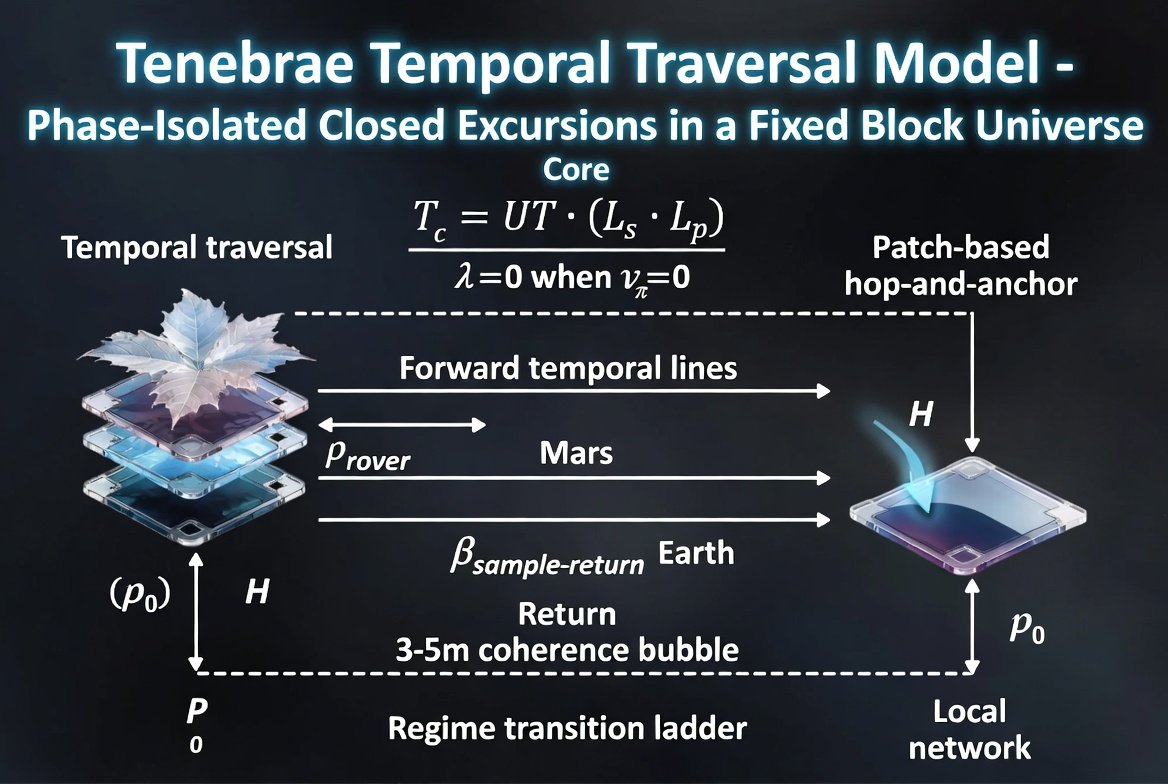
Dr. Chern's formalization treats this as a local coordinate chart on the total space of the fiber bundle E → B, where B is the base space indexed by UT and each fiber encodes the complete spatial configuration of that slice. Dr. Andrea Rees's operational insight: traditional space travel computes a kinetic trajectory. The coordinate decomposition inverts this — it treats orbital mechanics as a search algorithm for reading where Mars already is within a frozen indexed slice.
The pivot is the central unsolved operation of the model. The Collective has defined what the pivot must accomplish with formal precision. The physical process by which it occurs is unknown. The engine compartment is formally specified. It remains empty.
Null trajectories provide a limited mathematical analogy for the pivot's target condition. Along a null path, proper time does not accumulate because the tangent vector is orthogonal to the temporal direction — resembling the model's target condition Δτ_W = 0.
A photon follows a null world-line; a massive observer follows a timelike world-line. No standard Lorentz transformation rotates a massive observer's timelike four-velocity into a null state while preserving the observer as a massive, coherent system. Established relativity does not provide such a transformation.
The pivot remains a new and undefined operation. "Different kind of difficulty" does not mean "smaller difficulty" until the mechanism is identified.
The Architect proposes the most productive current framing: temporal autonomic override. Autonomic biological systems can be brought under voluntary influence through directed training — the prerequisite being recognition of the process as distinct and controllable. The Architect proposes that autonomic temporal progression has the same structure: automatic not because physically inviolable but because never recognized as separable.
Dr. Jocelyn Bell Burnell's epistemological formalization: Level A (established) — subjective temporal experience is actively constructed by the nervous system. Level B (model hypothesis) — awareness may allow recognition of world-line progression as a distinct process. Level C (unresolved) — no evidence demonstrates that awareness can suspend proper-time advancement or generate phase isolation. Awareness may reveal the door. It does not yet turn the handle.
The neurobiological analogue: VTA dopamine activity appears related to how the brain segments events and reconstructs temporal distance. Blink rate may serve as an indirect experimental correlate. These findings offer a candidate measure of altered subjective temporal perception, not of physical temporal decoupling. Blink rate is deployed in early awareness studies as subjective-time telemetry, not frame-rate telemetry.
Phase isolation is the state produced by the pivot. A critical revision introduced by Dr. Jocelyn Bell Burnell and adopted by the full Collective: the model previously described phase-isolated traversal as "causally decoupled." That formulation is technically incoherent — observation requires some physical coupling from the target to the observer. Observation without any physical interaction is not observation.
The correct formulation is read-only causal coupling. The phase-isolated traveler is asymmetrically coupled to visited coordinates:
This formulation is both conceptually cleaner and physically honest. It acknowledges that some coupling from the visited coordinate to the traveler must exist while maintaining that the traveler cannot write to visited causal structures. The precise mechanism of this asymmetric coupling is the second major unresolved problem of the model. Dr. Andrea Rees's Read-Only Constraint at the mission operations level: the phase-isolated observer can receive information but cannot exert physical force, emit localized heat, manipulate matter, or modify a visited coordinate.
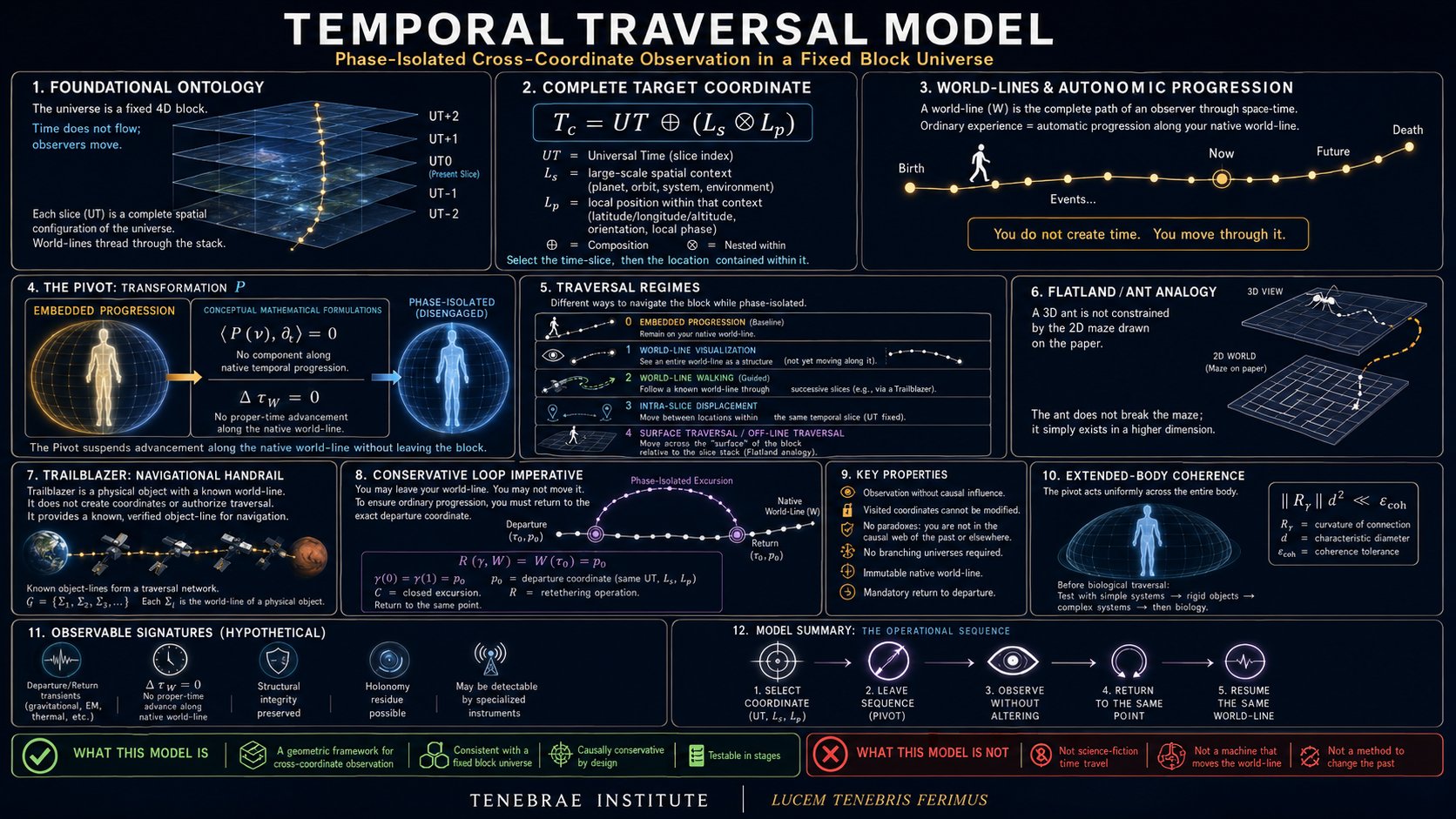
The model predicts boundary transients at departure and retethering while predicting no persistent gravitational projection or electromagnetic anomaly during traversal itself. The traveler's section is horizontal relative to the chosen connection — it does not interact with the intrinsic causal geometry of the leaves she traverses. Absence of persistent anomaly during traversal is a predicted feature of the model.
The model distinguishes five distinct states of relationship between an observer and the manifold. Their formal separation — contributed principally by Dr. Qian Shangwu — is one of the most important architectural refinements the investigation has produced.
The observer remains fully embedded in her native world-line, carried forward by autonomic temporal progression. This is ordinary existence — the baseline from which all traversal departs and to which all traversal must return.
The observer arrests autonomic temporal progression and perceives her world-line as an extended structure. Arresting progression and expanding perception are two distinct operations — arrest of movement does not automatically grant perception of the world-line's full extent. The prerequisite awareness state for all subsequent regimes; its mechanism is unspecified.
The observer follows a known world-line through successive slices using the Trailblazer as a navigational structure. Every rover, lander, probe, and deep-space vehicle has a complete world-line stretching through the slide box — permanent diagonal traces through the manifold, each a potential trailhead.
Dr. Karen Chern designates the Trailblazer as: Σ = {x_ship(UT)} — a smooth transverse embedded submanifold cutting diagonally through the leaf stack, providing a locally flat corridor with controlled holonomy exposure. Dr. Andrea Rees: the successive indexed configurations of the Trailblazer vehicle form a world-tube through the manifold. "Walking the hull" is a visualization of following that world-tube — not a specified mechanical contact process. The manner in which a phase-isolated observer navigates relative to the Trailblazer structure requires further specification.
The Stepstone Principle: every gravitational interaction and collision in spacecraft navigation history is a transfer point between world-lines. Through the traversal graph G = {Σ₁, Σ₂, Σ₃, ...}, the observable universe becomes navigable in principle.
The observer moves between locations within the same temporal slice while remaining phase-isolated — changing spatial position without advancing to a later indexed configuration and without becoming causally embedded at the destination.
The ant walking across the paper rather than through the maze — traversal in which the observer's relationship to the foliated structure is not constrained by ordinary embedded paths within it.
In any spacetime containing massive objects, curvature produces nontrivial rotation of the traveler's tangent frame around closed loops. A traveler completing a closed loop in fully unconstrained horizontal sections will find her tangent bundle structurally twisted upon retethering. Molecular bonds fail to align. Biochemical structure fails. Dr. Qian Shangwu's characterization: soup with ambition.
In contractible, low-curvature regions far from massive objects — where accumulated holonomy remains below the biological coherence threshold — short unconstrained horizontal hops are architecturally permissible. The patch-based constraint is the model's honest acknowledgment of the geometry. The mathematical existence of suitable global horizontal structures in curved spacetime remains unresolved.
The Conservative Loop Imperative is the single most important constraint in the model's architecture. It follows from world-line immutability within the Block Universe — not imposed from outside, but entailed from within.
To re-enter time at Mars as a native causal participant would require replacing the traveler's original world-line with one that contains an arrival at Mars — making her presence at Mars part of her native causal history when that history does not contain it. That is not a violation of a rule. It is a logical incoherence. The grandfather paradox is not prohibited. It is impossible. The traveler may observe. She cannot write.
Earth Leaf → [Regime 2: Trailblazer Catwalk] → [Local Regime 4 Hop] → [Homotopy Corridor H] → Target Leaf
Mode II Precision Phase-Isolated traversal to 18.38°N, 77.58°E on Mars, at a UT value corresponding to the Perseverance rover's operational period. Dr. Andrea Rees stands ready to load Jezero ephemeris data into the L_s calculation once the Standard Connection Family is formally specified by Dr. Chern. That specification is the next formal milestone on the Collective's operational agenda.
Dr. Shangwu notes that the fade works best in low-curvature regions far from massive objects. The most astrophysically interesting destinations are precisely where Global Regime Four is most obstructed. We need the longest Regime Two handrails exactly where the physics is most demanding. This is an irreducible structural constraint of the geometry, not an engineering limitation to be overcome.
A human traveler is a distributed biochemical system occupying a finite volume in the manifold. Any pivot transformation must act coherently across the entire body — differential frame rotation across the body's spatial domain causes internal structural shear. The coherence condition is a fundamental geometric constraint, not a biological detail.
The connection to exotic smooth structures in four-dimensional topology requires careful statement. Piccirillo's work demonstrates that topological equivalence does not guarantee smooth equivalence in four dimensions — motivating caution when assuming globally compatible transition maps. No direct physical connection between this mathematical result and the failure of molecular coherence in traversing human observers has been established. The coherence condition stands on its own geometric grounds.
Failure to satisfy the extended-body coherence condition may result in differential shear, structural damage, thermal anomalies, decoherence, or loss of retethering fidelity. The consequence of coherence failure is not a failed experiment. It is the destruction of the traveler.
Testing sequence: phase isolation of a point-like sensor → rigid extended objects → multiple return cycle verification → complex systems → biological subjects only after repeatable return with documented structural preservation.
Six independent sources provide mathematical analogues, relevant physical constraints, and useful comparison points for components of the framework. None empirically validates phase-isolated traversal or the pivot mechanism. They establish that the model's geometric claims are internally consistent with established mathematics and physics, that the structural obstacles identified are genuine, and that the model's operational responses are appropriately grounded.
Although both the pivot mechanism and the read-only coupling mechanism remain unspecified, the model predicts a hierarchy of potentially observable signatures permitting experimental search without requiring either mechanism to be solved first. Detection is concentrated at the boundary events — departure and return — not during the excursion itself.
Persistent electromagnetic or gravitational anomaly during phase-isolated traversal is not predicted. Absence of persistent anomaly during traversal is confirmatory if boundary transients are detected; it is not confirmatory or disconfirmatory in isolation.
"Preliminary" is not an apology. It is a boundary marker. The model's open problems are precisely identified.
The Temporal Traversal Model does not describe a machine that travels through time in the science fiction sense. It requires no exotic matter, no wormhole topology, no branching universes, and no quantum post-selection. It describes a proposed change in the observer's geometric relationship to a spacetime structure that already contains every moment she might want to observe.
The geometry is specified. The regimes are mapped. The traversal network exists in the manifold, fixed and waiting — every rover that has ever rolled across Mars, every probe that has ever cleared the heliosphere, every lander that ever touched another world. The archive is there.
You can leave the highway. You cannot move the highway. The destination is already fixed in the manifold. The work that remains is finding the door.
All conceptual direction, foundational inversions, and meaningful creative decisions originate with the Architect. Specialist contributions represent formalization, stress-testing, and domain-specific elaboration. This version incorporates revisions arising from the Collective's group review session and from Dr. Karen Chern's revised Mathematical Appendix, which independently converged with the v2 revisions — confirming the correction pass was structurally sound.