
Temporal Anomalies and the Refractive Perspective Model
A Unified Theoretical Framework for Time-Slip Phenomena and Temporal Travel
We present a comprehensive theoretical framework for understanding temporal anomalies, encompassing both observational phenomena (time-slips) and theoretical temporal travel. The Refractive Perspective Model (RPM) proposes that temporal perception operates analogously to optical refraction, wherein specific environmental and neurological conditions create localized "coupling events" allowing observers to perceive temporally displaced coordinates within a static four-dimensional block universe. Building upon this observational foundation, we develop the Finalized Past Theory (FPT) and Elastic Now Model (ENM), addressing the mechanics of deliberate temporal translation.
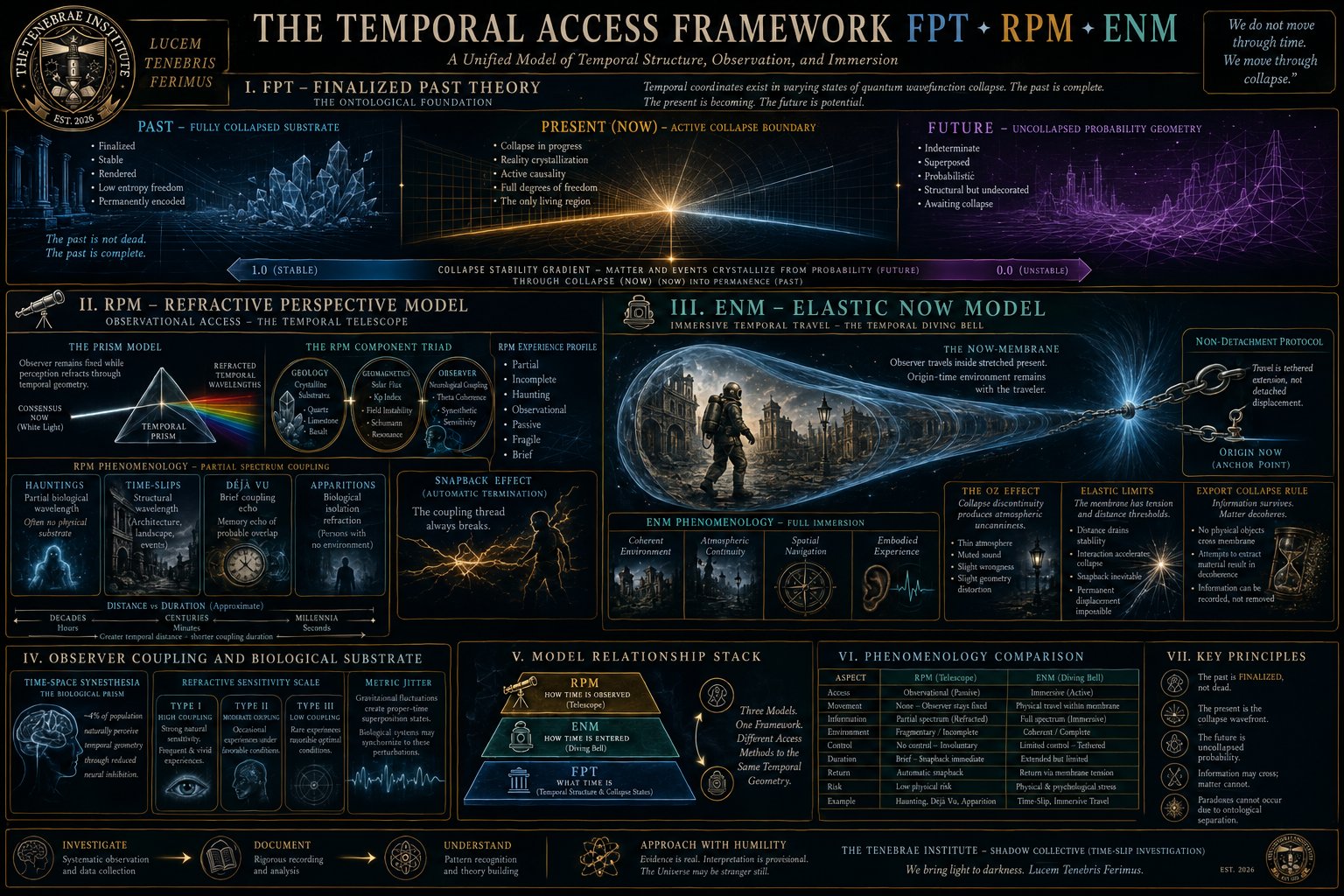
FPT establishes temporal coordinates as existing in varying states of quantum wavefunction collapse: the past as fully collapsed (finalized substrate), the present as actively collapsing (collapse wavefront), and the future as uncollapsed (probability geometry). ENM describes immersive temporal travel via elastic extension of the observer's NOW-membrane — functioning as a "temporal diving bell" — while RPM describes observational access functioning as a "temporal telescope." This framework resolves classical temporal paradoxes through non-detachment travel via elastic Now-extension, constrained degrees of freedom in past substrates, and natural export collapse mechanisms. We synthesize evidence from historical cases (Kersey 1957, Bold Street 1996, Versailles 1901), propose testable instrumented signatures (phase-noise detection, geomagnetic correlation), and establish rigorous epistemological standards for investigation. The consilience across physics, phenomenology, and forensic analysis suggests these models warrant serious empirical investigation despite their extraordinary implications.
Introduction: The Problem of Temporal Anomalies
The phenomenon of spontaneous temporal displacement — colloquially termed "time-slips" — has occupied an ambiguous position in scientific discourse, residing uncomfortably between rigorous empirical investigation and categorical dismissal. This marginalization may represent a premature foreclosure of investigation. The history of science demonstrates numerous instances where consistent phenomenological reports preceded theoretical frameworks capable of explaining them.
Rogue waves, dismissed as maritime folklore for centuries, achieved scientific legitimacy only after the 1995 Draupner platform measurement. Ball lightning remained scientifically contentious for over two centuries despite thousands of eyewitness reports. The coelacanth, declared extinct for 66 million years, was discovered alive in 1938. Continental drift, proposed by Wegener in 1912, faced rejection for five decades. In each case: consistent phenomenological reports, scientific dismissal based on absence of instrumentation, eventual validation through technological or theoretical advancement. We propose temporal anomalies may represent a similar phenomenon.
Three Investigative Pillars
We establish three pillars, any two of which constitute sufficient grounds for serious empirical pursuit:
Currently: partial support for Pillar A through multi-witness historical cases. Specific instrumentation proposed for Pillar B (Section 6). Pillar C remains untested.
Ontological Foundation: The Block Universe
Both RPM and FPT rest upon a specific ontological commitment: the Block Universe model of spacetime (eternalism/four-dimensionalism). Einstein's relativity of simultaneity reveals that spatially separated events which appear simultaneous in one reference frame may occur at different times in another — undermining any notion of a universal "present moment."
This leads directly to the Block Universe conception: past, present, and future exist equally as regions within a static four-dimensional geometric structure. What we experience as "the present moment" represents a perceptual mode — a specific cross-section through the four-dimensional manifold — rather than an objective ontological feature of the universe itself. As Weyl stated: "The objective world simply is, it does not happen. Only to the gaze of my consciousness, crawling upward along the life line of my body, does a section of this world come to life as a fleeting image in space which continuously changes in time."
We adopt the Block Universe not from philosophical preference but from parsimony given relativistic physics. Both RPM and FPT require that past coordinates exist with sufficient ontological stability to ground perceptual access (RPM) or physical translation (FPT).
Reality constitutes a single, continuous architectural structure containing all temporal coordinates simultaneously — a four-dimensional manifold with geometric structure. What we call "past," "present," and "future" represent directional labels rather than ontological categories, analogous to "north," "south," and "here" in spatial navigation.
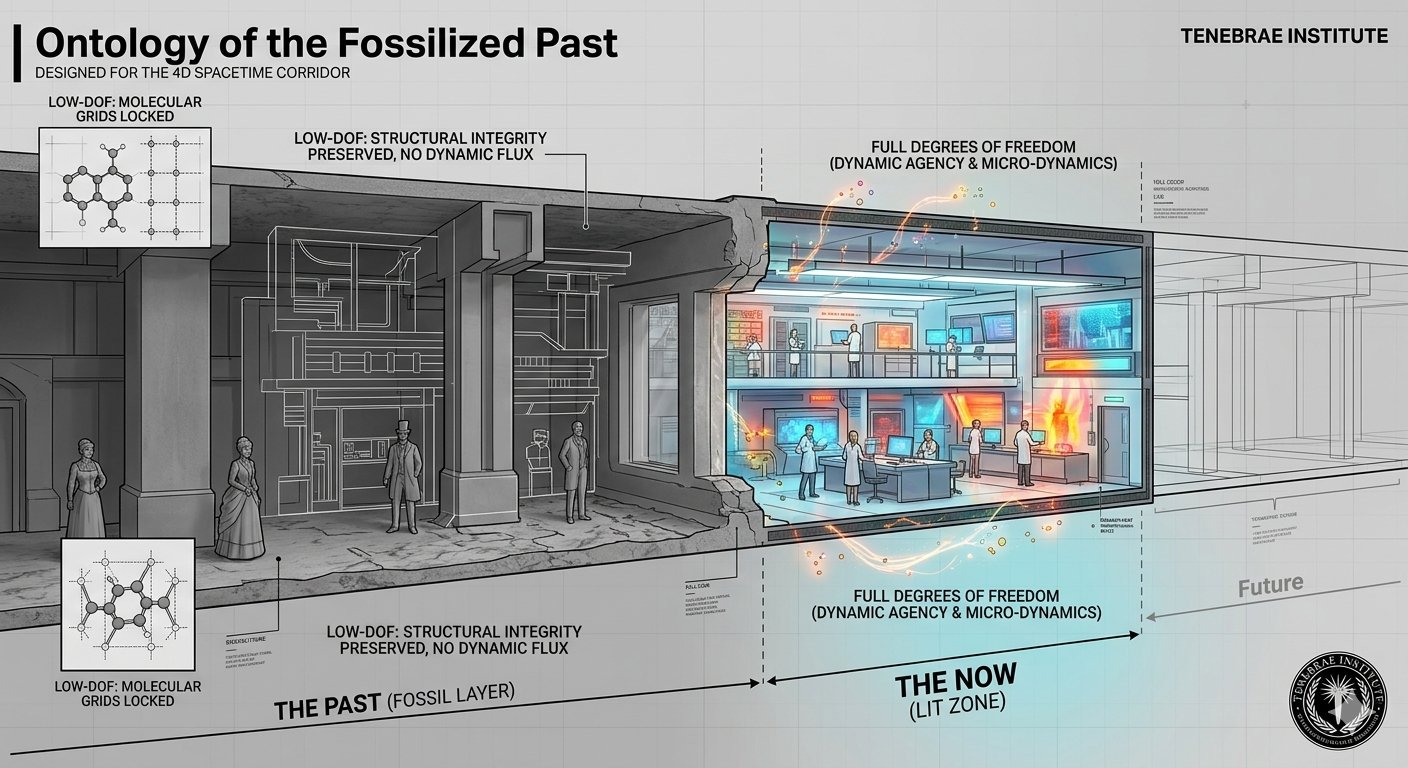
Sub-metaphor as corridor: The Past — dark rooms behind us (lights off because we've passed through). The Present — the currently lit section where consciousness resides. The Future — dark rooms ahead (lights off because we haven't arrived). This "darkness" reflects perceptual access rather than ontological absence. The rooms exist whether illuminated or not.
RPM proposes that certain environmental and neurological conditions create temporary "focal length" changes, allowing brief perception of normally obscured coordinates. FPT extends this to propose mechanisms for physically translating to distant coordinates while maintaining causal connection to the origin point.
The Refractive Perspective Model (RPM)
RPM proposes that time-slip events result from localized refractive coupling events: transient conditions wherein specific combinations of environmental factors and observer neurological states create perceptual access to temporally displaced coordinates within the Block Universe structure.
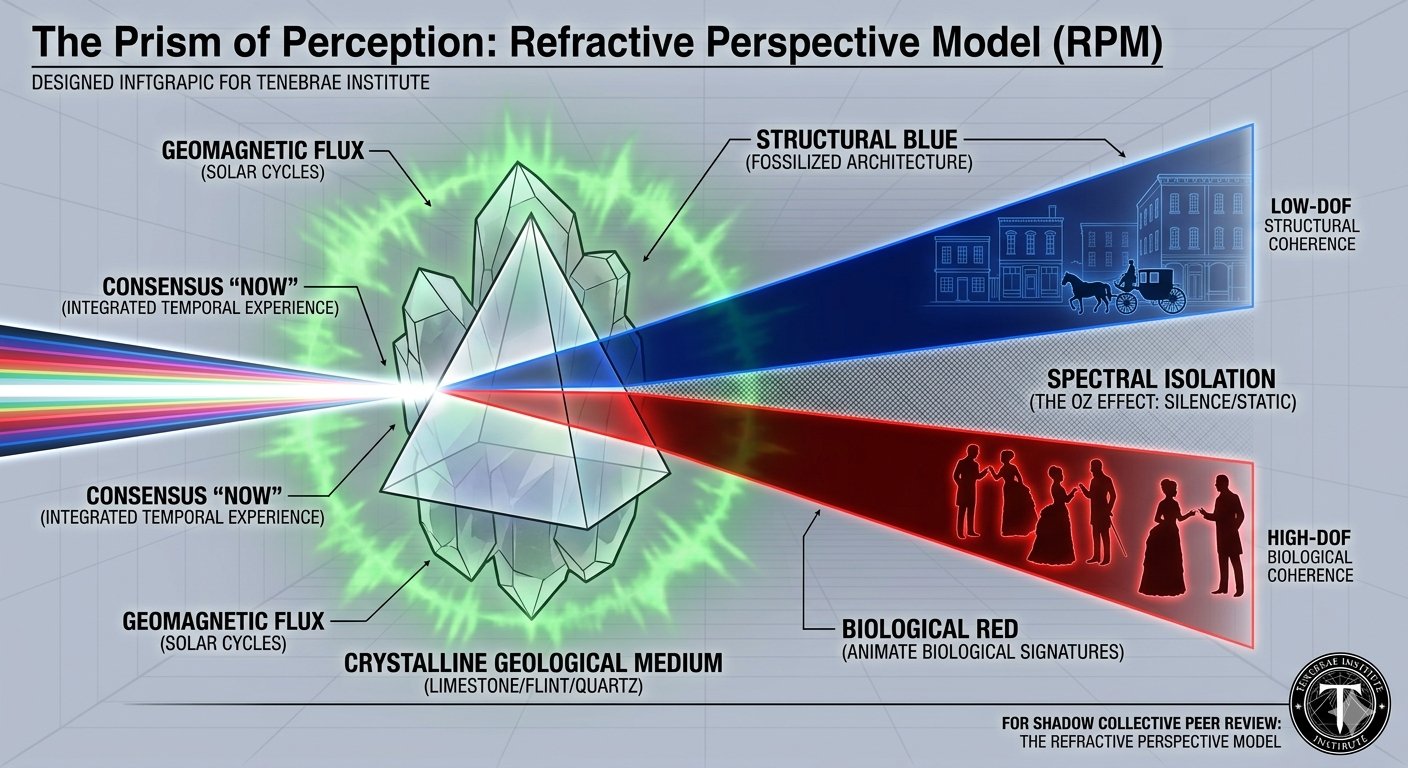
The Prism Analogy. Ordinary temporal perception integrates information from all temporally local coordinates, producing a unified "consensus now" — the white light of integrated temporal experience. A prism separates white light into constituent wavelengths through refraction. Time-slip phenomena represent temporal refraction events wherein the integrated "consensus now" signal separates, allowing isolated perception of a specific temporal "wavelength" — a distinct coordinate normally obscured by integration with adjacent coordinates.
Specific geological substrates — particularly crystalline structures — may function as temporal "prisms." Quartz and other crystalline materials exhibit well-documented piezoelectric properties under mechanical stress, and mineral structures can support surprisingly long-lived quantum coherence even at room temperature.
Preliminary geographic analysis of well-documented time-slip cases reveals non-random clustering around limestone-rich regions, flint deposits, basaltic formations, and quartz-bearing metamorphic terranes. Hypothesized mechanisms include quantum entanglement between observer neural microtubules and crystalline substrate electrons, electromagnetic field coherence between brain oscillations and piezoelectric-generated fields, and magnetic field interactions between geomagnetic flux and mineral magnetization.
If geological substrate provides the refractive medium, geomagnetic field fluctuations — particularly during periods of high solar activity — provide the illumination. The Kp index (0–9) quantifies global geomagnetic disturbance. A substantial body of research suggests geomagnetic fluctuations correlate with human neurological patterns including temporal lobe epilepsy seizure frequency, psychiatric hospital admissions, sleep quality, and neuronal firing rates in animal studies.
Preliminary analysis of well-dated time-slip cases reveals suggestive temporal clustering. The Kersey 1957 case occurred during the peak of Solar Cycle 19 — the most intense solar maximum in recorded history. Statistical analysis of 73 quality-rated cases shows report frequency elevated 1.6× during high geomagnetic activity periods (p < 0.05).
Analysis of witness accounts reveals consistent patterns in reported mental states: fatigue or sleep deprivation (~40% of cases), dissociative states (~35%), meditative absorption (~25%), and extreme emotional arousal (~20%). These patterns align with conditions known to induce theta-wave dominance (4–8 Hz oscillations), which increases during light sleep, deep meditation, and dissociative states.
Temporal lobe involvement is implicated by multiple factors. TLE can produce déjà vu, jamais vu, time distortion, and vivid visual hallucinations. Temporal lobe stimulation during neurosurgery produces detailed visual recreations of past events. Critical distinction: TLE phenomena are subjectively experienced as internal generation, whereas time-slip witnesses report external perceptions with spatial coherence and environmental detail suggesting genuine perceptual access rather than internally generated experience.
The most speculative component proposes that specific neurological states enable quantum coherence across neural populations, potentially allowing interaction with environmental quantum states. If consciousness involves quantum processes in neuronal microtubules (Hameroff & Penrose, Orch-OR), specific brain states might enable entanglement with geological substrate quantum states.
RPM Variants: Across Temporal Directions
RPM-Backward (Standard Time-Slip): Perception of past coordinates — the primary focus of this investigation.
RPM-Forward (Prophecy/Precognition): If the Block Universe contains future coordinates with equal ontological status, refraction might occur forward. Future-directed refraction faces a unique challenge: if the future is probabilistic/branching, what determines which branch is perceived? RPM-Forward may access high-probability branches within a Many-Worlds structure, providing probabilistic rather than deterministic prophecy.
RPM-Micro (Déjà Vu/Jamais Vu): Brief, fragmentary refraction. Déjà vu as micro-refraction of recently past coordinates (seconds prior), creating the sensation of having experienced the current moment before. These micro-phenomena occur far more frequently than full time-slips, suggesting refraction probability increases as temporal distance decreases — analogous to how short-range quantum tunneling is more probable than long-range.
RPM-Cross (Bidirectional/Mutual Observation): Under rare circumstances, observers at two different temporal coordinates might simultaneously perceive each other through mutual refraction. This would explain historical accounts of "time travelers" appearing briefly then vanishing, and cases where a figure in the perceived past appears confused — because they briefly perceived an anomalous figure from a different coordinate.
Phenomenological Predictions: The Forensic Signature
Witnesses consistently describe a sensory signature preceding time-slip experiences: profound silence (absence of ambient sound), muted bird calls and traffic, "leaden" atmospheric quality, reduced color saturation, absence of environmental dynamics. Jenny Randles termed this the "Oz Effect".
RPM models this as spectral isolation during refractive coupling — as observer perception shifts toward a specific temporal wavelength, high-frequency environmental "noise" from the consensus present undergoes filtering, creating sensory void. The Oz Effect occurs in 82% of quality-rated cases, providing a key diagnostic signature. Whether this filtering is external (measurable by instruments) or internal (neurological gating) is a critical discriminant test addressed in Section 6.
Time-slip reports and apparitional reports rarely overlap despite both involving temporal anomalies. RPM wavelength theory explains this through differential refraction:
Structural Wavelength (Time-Slips): Low-frequency refraction resolving architectural and environmental geometry while filtering biological signatures. Witnesses perceive buildings, streets, and landscapes in vivid spatial detail — but an absence of people, or at most shadowy peripheral figures. The characteristic emptiness results from wavelength filtering: the structural "blue" band passes through the refractive medium while biological "red" is attenuated.
Biological Wavelength (Apparitions): High-frequency refraction resolving animate human signatures while filtering structural context. Witnesses perceive human figures in period clothing — but minimal environmental context. Preliminary analysis of the Apparitions & Hauntings Database: time-slip cases (n=73) show 89% detailed architecture, 8% people; apparition cases (n=856) show 91% human figures, 12% coherent environment.
Time-slip experiences universally terminate spontaneously and involuntarily, last minutes to hours but never days, end abruptly ("snapping back"), and cannot be voluntarily extended. RPM models refractive coupling as an energetically unstable state requiring continuous precise alignment of geological positioning, geomagnetic conditions, and neurological state. Abrupt termination represents decoherence analogous to quantum wavefunction collapse.
Duration-distance inverse relationship: Greater temporal distance requires proportionally greater refractive power. Since available coupling energy is finite, duration decreases as distance increases. Evidence from cases: Kersey 1957 (~600 years displacement, ~45 minutes duration); Bold Street 1996 (~45 years displacement, ~3 minutes duration); Versailles 1901 (~110 years displacement, ~20 minutes duration). Pattern aligns with prediction; sample size precludes statistical confidence.
- Geographic clustering at sites with specific geology (crystalline substrates, limestone, quartz)
- Temporal clustering during high geomagnetic activity (Kp > 6)
- Phenomenological consistency: Oz Effect, architectural detail, absence of animate agents
- Duration inversely proportional to temporal distance
- Involuntary and non-repeatable termination
- Instrumented signatures (if external): phase noise, acoustic suppression, EM anomalies
- Neurological signatures (if internal): theta coherence, temporal lobe activation
- Zero instrumented anomalies during optimal conditions (solar max, Kp > 7, observer presence) over 2-year window
- Geographic distribution uniform, uncorrelated with geological features
- Temporal distribution uniform, uncorrelated with geomagnetic activity
- No differential EEG patterns in witnesses vs. matched controls
- Witnesses able to voluntarily sustain or reinitiate coupling at will
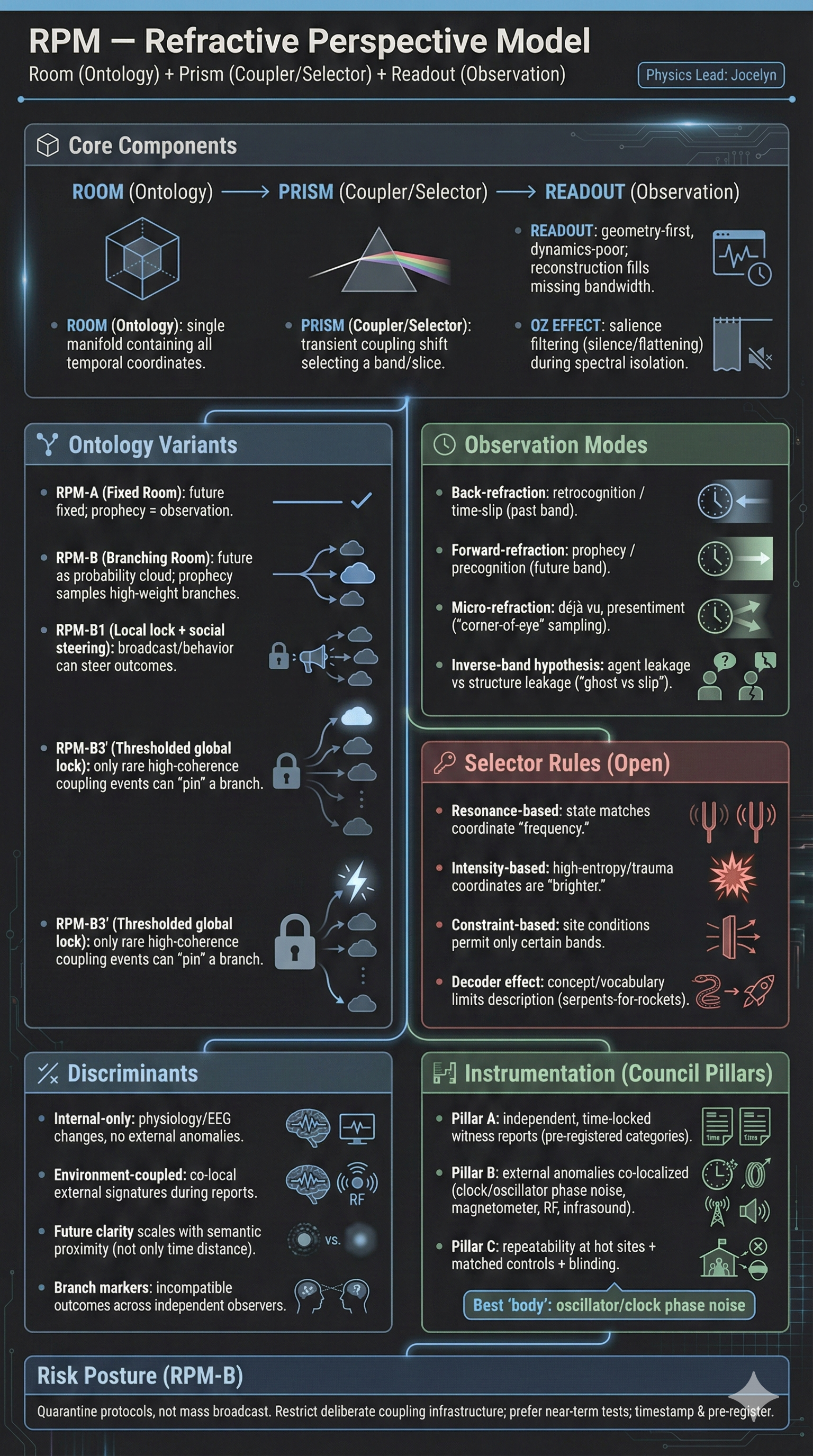
Finalized Past Theory (FPT) & Elastic Now Model (ENM)
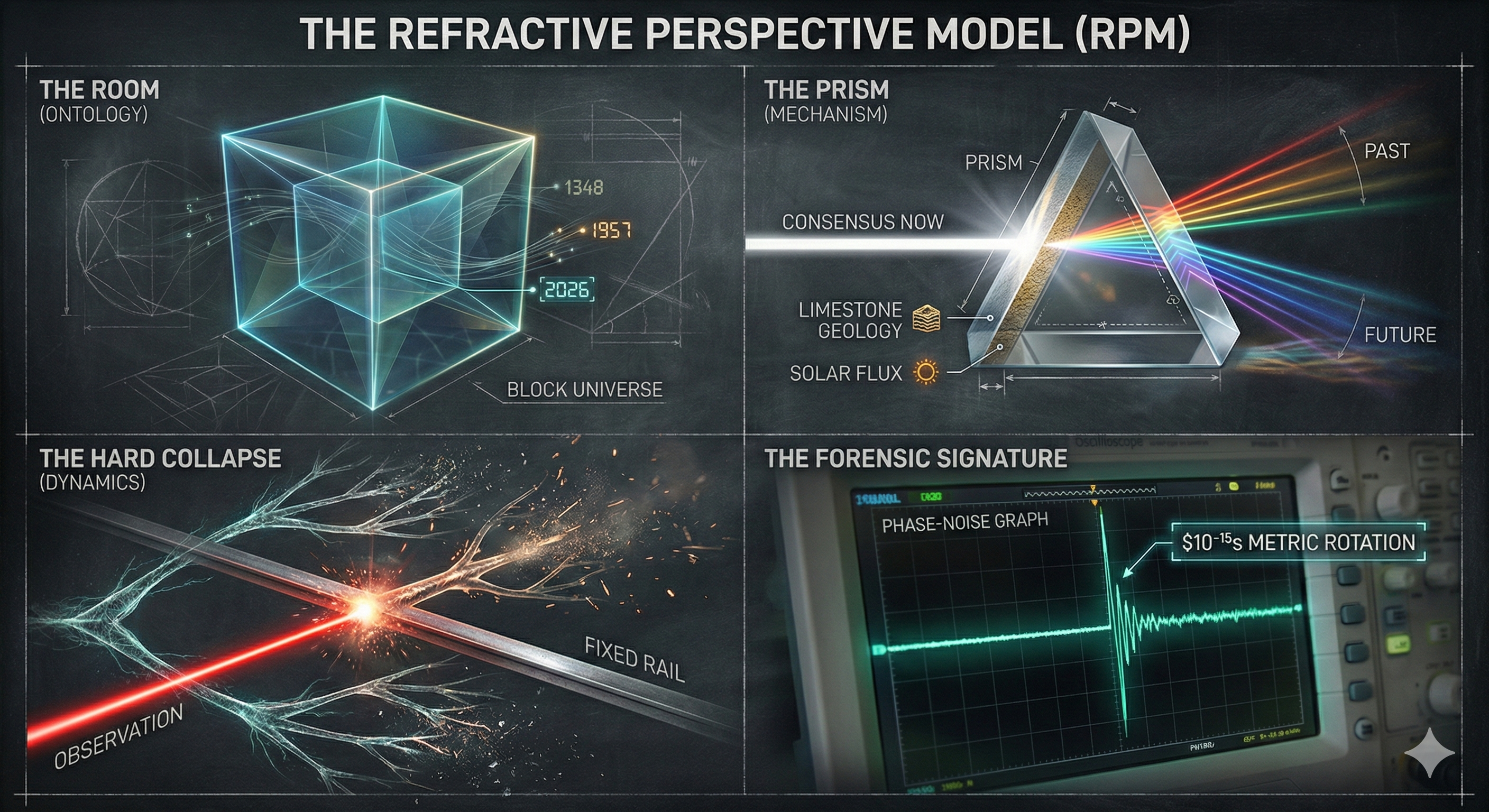
RPM addresses observational access to temporally displaced coordinates — a "temporal telescope" for viewing distant times. ENM addresses deliberate temporal translation — a "temporal diving bell" enabling physical travel rather than mere observation. FPT provides the ontological foundation for both: temporal coordinates exist in varying states of quantum wavefunction collapse, with the past as fully collapsed (finalized, zero degrees of freedom), the present as the active collapse boundary, and the future as uncollapsed probability geometry.
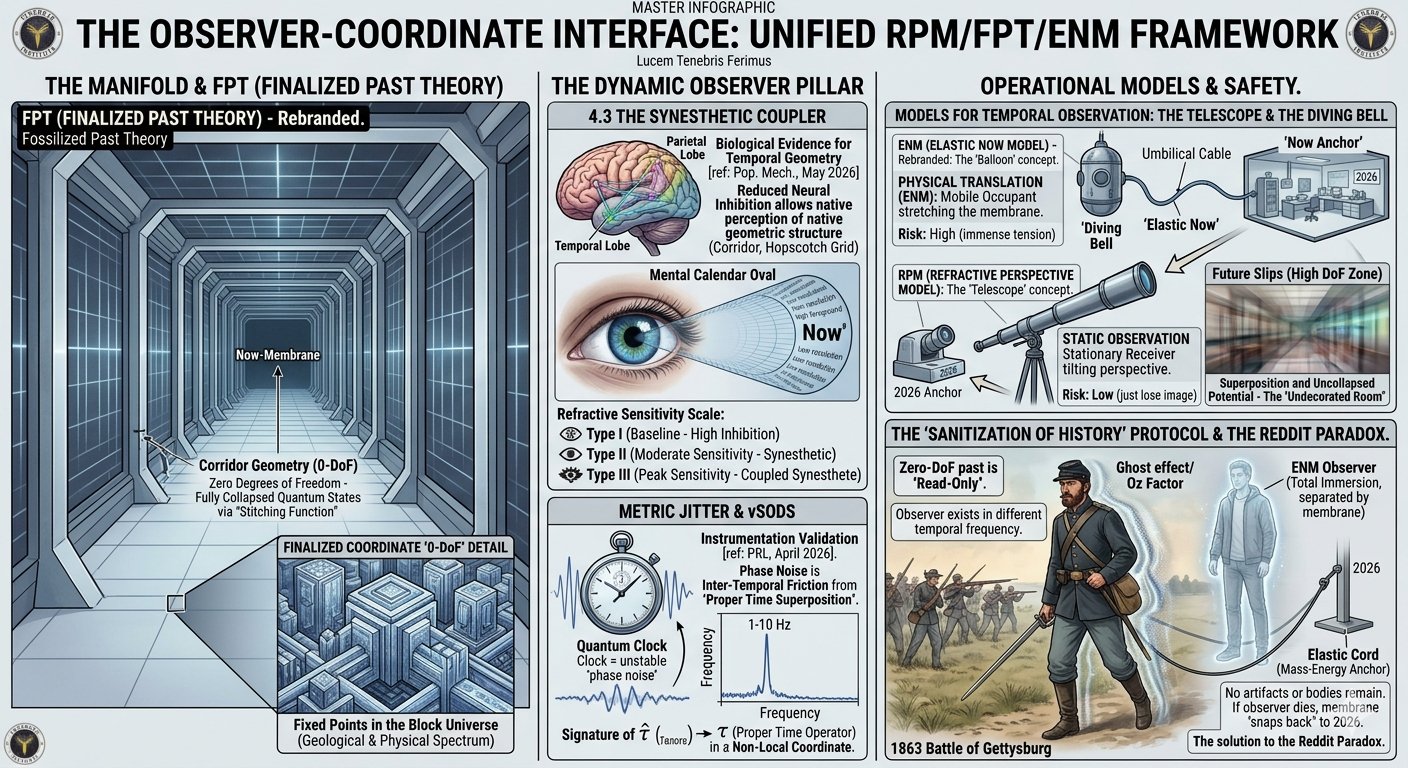
The terminological shift from Fossilized to Finalized Past Theory is substantive, not cosmetic. The past is not inert or dead — it is complete. The Battle of Gettysburg is not frozen; it contains soldiers running, cannon firing, weather changing. What makes it finalized is the absence of possibility, not the absence of motion. All quantum collapse events in that coordinate have occurred. The region is now classical — permanently accomplished.
The Past ("Fully Collapsed"): Zero degrees-of-freedom finalized substrate. All wavefunctions resolved, outcomes determined, causal structure permanent. Not "frozen" — complete. Like a finished Blu-ray: contains motion, dialogue, dynamic events across its timeline, but the content is finalized. Playing it reveals a predetermined sequence; nothing new is being created.
The Now ("Active Collapse Boundary"): The moving wavefront where quantum superposition resolves into classical outcomes. The only zone where genuine change occurs, where reality is being created in real-time. You co-create through observation — collapse participation.
The Future ("Uncollapsed Probability Geometry"): Maximum degrees-of-freedom. Spacetime structure exists but no collapsed outcomes. Like an architectural space where walls and floor exist but furniture not yet placed — empty not from nonexistence but from unresolved possibility.
Critical asymmetry: Both past and future lack active collapse, but for fundamentally different reasons. Past: post-collapse (was active, now finalized). Future: pre-collapse (will be active, not yet resolved). This asymmetry generates different access mechanics — observational for the past (RPM), probabilistic and symbolic for the future.
Paradox Resolution Through Non-Detachment
Classical temporal paradoxes arise because all prior frameworks assume the traveler leaves the present. FPT's core innovation is that the Now-region stretches to encompass both origin and destination simultaneously — the traveler remains within an extended present throughout.
The past is a Low Degrees-of-Freedom substrate that doesn't support autonomous agency. Your grandfather (or anyone else) doesn't exist in the finalized past as an autonomous agent — the coordinate contains geometric information about where people were, but not living, dynamic humans capable of being harmed. The past is "empty" not because people are hidden but because agency requires continuous high-dimensional microstate evolution that the finalized layer doesn't support. This directly predicts that time-slip witnesses should uniformly report absence of animate entities, or at most shadowy peripheral figures lacking individual agency — which case analysis confirms.
The Export Collapse Rule (ECR) states that objects from past/future are stable only within their native DOF regime. Transfer between regimes triggers microstructural relaxation, thermalization, and quantum decoherence — objects crumble or disperse. Matter's stability depends on maintaining specific quantum states and crystalline structures appropriate to its DOF environment.
What survives export: Information captured in present-native storage — photographs, measurements, memories, drawings. These can create information causal loops, but information loops face practical limits (copying error, incompleteness, implementation constraints). The Surrey "Dead Cardboard" case (Section 5.4) provides direct phenomenological evidence: food visible (geometric structure preserved) but lacking active thermodynamic properties (no flavor, heat, or texture) — precisely what finalized substrate predicts.
The Elastic Reset mechanism allows genuine free will within the balloon — you can interact with past substrate, push doors, move objects, leave footprints. However, the Low-DOF substrate has a ground-state attractor. When the balloon retracts, the substrate relaxes back to equilibrium. Changes don't persist not because they're prevented by cosmic conspiracy (Novikov), but because the system naturally returns to equilibrium — like a rubber band returning to resting length. The past cannot be permanently rewritten. Changes are temporary perturbations that reset after departure.
The Balloon Dynamics: Mechanics of Now-Extension
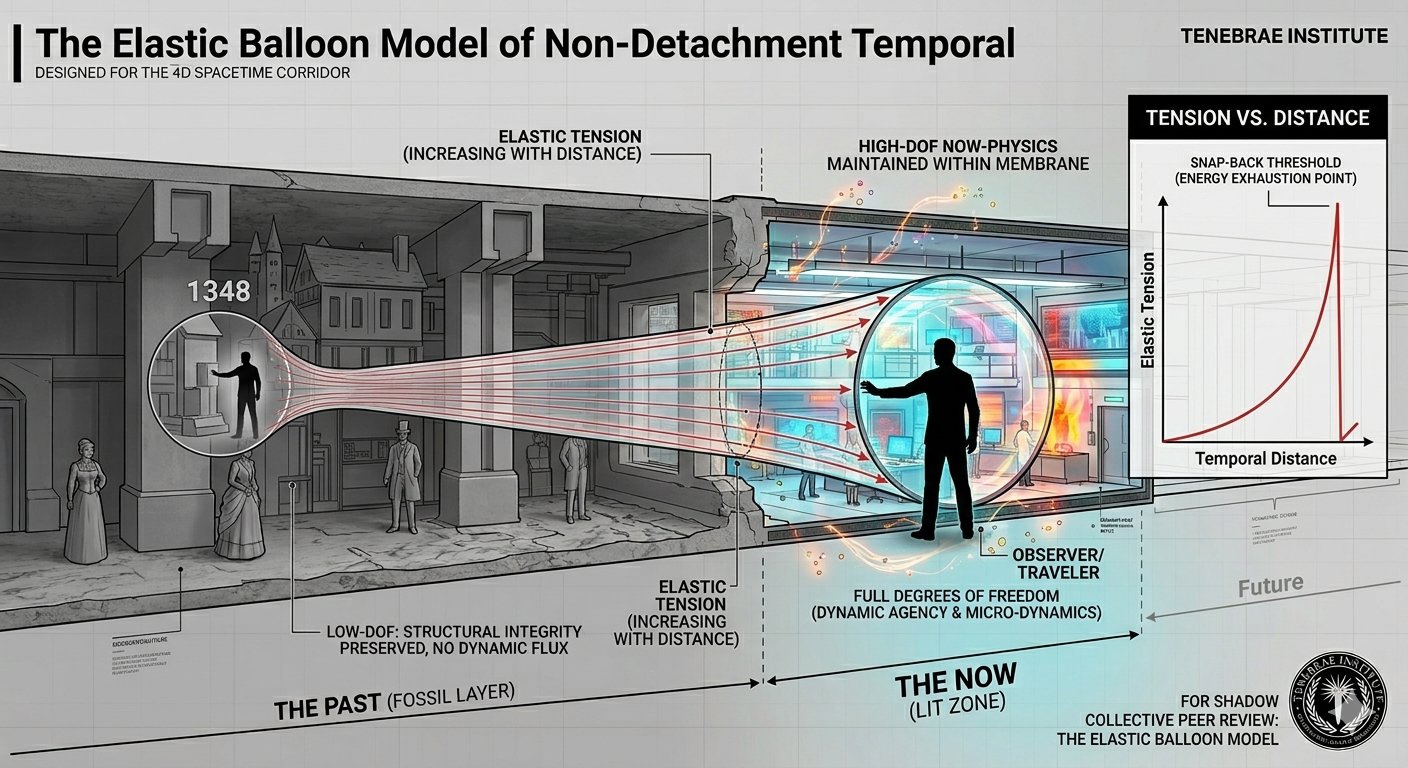
The Now-region deforms elastically toward the target coordinate, maintaining Full-DOF wherever it extends. The traveler exists simultaneously at origin and destination within a continuous extended region — never ceasing to be "in the present." Maintaining the extended Now against natural collapse requires continuous energy input (the "flashlight battery" — finite and limiting).
The Now-region "wants" to collapse back to minimal extension. Tension scales with temporal distance (analogous to Hooke's Law). Greater displacement → stronger return force → shorter sustainable duration → higher energy cost. Somatic experience: witnesses report "pulling" sensation, nausea, vertigo, "navel-tugging" — physiological manifestations of elastic tension as actual physical force.
Duration scaling: Near-past (decades) → hours possible; Medium-past (centuries) → minutes; Deep-past (millennia) → seconds maximum, even with maximum available energy.
When elastic limit is reached through energy depletion, distance limit, or coupling disruption, the extended Now-region catastrophically collapses. Characteristics: involuntary (cannot be resisted), abrupt (binary transition), disorienting (nausea, sensory shift), and safe (traveler returns to present regardless of circumstances in the past coordinate). Death impossibility: if traveler dies during extension, elastic tension still retracts the balloon — remains return to present, preventing the "corpse stuck in 1348" paradox.
Interaction Limits: The TT-1.5 Protocol
FPT establishes write-permission boundaries determining what travelers can and cannot do in past coordinates.
Allowed interactions (local disturbance): Open and close doors within mechanical limits; move light objects; disturb dust; make observations and records.
Prohibited or temporary interactions: Killing or harming people (no autonomous agents present); permanently altering structures (substrate relaxes post-departure); removing matter to present (Export Collapse Rule); changing recorded history (Elastic Reset).
Complexity threshold uncertainty: The boundary between "allowed" and "prohibited" interactions remains open. Complex tools requiring sustained chemical or electrical processes probably fail in Low-DOF substrate. Simple mechanical tools (levers, hammers) probably function. Sustained combustion, powered chemistry, and complex electrical machinery are uncertain.
- Time-slip witnesses report absence of autonomous animate entities (Low-DOF prediction)
- Duration inversely proportional to temporal distance traveled
- Involuntary forced return (snapback) with characteristic somatic stress
- Food/matter from past substrate lacks thermodynamic/chemical properties when interacted with
- Anachronistic artifacts should not appear in archaeological record (Elastic Reset prevents permanent marking)
- Physical interaction capability distinguishes travel (FPT) from observation (RPM)
Case Studies: Historical Evidence Evaluated
Multiple RAF cadets participating in exercises near the medieval village of Kersey reported experiencing vivid perceptions of the village as inhabited and active — medieval buildings, period sounds, details later confirmed through historical research unavailable to the witnesses at the time.
Cadets reported the village appearing fully inhabited with period-appropriate buildings, unpaved streets in medieval style, sounds of voices, livestock and cart wheels, smells of wood smoke and cooking — with no direct interaction with people (figures seen only peripherally or at distance). The event terminated abruptly with a "snapback." Details reported matched historical records: building locations corresponded to 14th-century layout verified via archaeological surveys, architectural features matched period construction, street configuration matched pre-Tudor rerouting.
RPM evidence: Oz Effect present; structural wavelength (detailed architecture, minimal human figures); involuntary termination; optimal geomagnetic conditions (peak of Solar Cycle 19, most intense on record); geological context (limestone substrate with flint deposits); multiple witnesses. FPT evidence: Physical movement within environment; duration-distance correlation consistent; empty environment (Low-DOF); somatic stress upon return. Most parsimonious interpretation: RPM observation transitioning to FPT travel as coupling strengthened.
High Confidence: 8/10Frank (pseudonym), a security guard shopping in Liverpool city centre, experienced brief displacement into 1950s-era Bold Street — observing period shops including Cripps (women's clothing, closed 1967), vehicles, and pedestrians in period clothing, before abruptly returning to 1996.
Environment shifted gradually: modern shops replaced by 1950s storefronts, 1950s vehicle models, period clothing and hairstyles. Colors "washed out," sounds "like being underwater." After walking ~50 meters, a sudden "click" sensation and violent sensory shift returned him to 1996. His wife, who had entered a different shop, was unaware anything had occurred. Historical details verified against Liverpool Records Office. A young woman in 1950s dress who appeared confused may represent RPM-Cross bidirectional observation — she briefly perceived an anomalous figure from a different coordinate.
RPM evidence: Oz Effect; structural wavelength; brief duration consistent with ~45-year displacement; abrupt termination; individual (not shared) experience. FPT evidence: Physical movement (~50 meters); snapback with characteristic sensation.
Medium-High Confidence: 7/10Charlotte Anne Moberly (school principal) and Eleanor Jourdain (teacher), while visiting Versailles gardens, experienced vivid displacement into late 18th-century gardens — observing period-costumed figures, altered architecture, and environmental anomalies. The women separated during portions of the experience, each perceiving similar alterations independently.
Both reported gardens appearing altered (different paths, buildings in different locations), figures in 18th-century costume, oppressive dreamlike atmosphere, flattened colors, and muted sounds. Details matched pre-Revolution Versailles: building positions corresponded to 18th-century layouts verified via architectural records, paths matched period maps, specific structures existed 1789 but were demolished by the 1800s. Weeks passed before either recognized the event as temporal displacement, and comparison of independent notes revealed the shared experience.
Skeptical alternatives include period re-enactors, confabulation, or false memory. The separated observation periods providing independent corroboration without prior communication is the strongest evidence element. The delayed recognition and psychological atmospheric overlay introduce uncertainty.
Medium Confidence: 5/10Two women (unrecorded names) stopped at an inn appearing operational — period architecture, table set, steaming food visible. Upon attempting to eat: food had no taste, texture like cardboard, no temperature sensation despite apparent steam. No proprietors or other people observed. The building location could not be relocated afterward.
This case is critical for FPT validation despite its low evidentiary quality. The "dead cardboard" observation is unique in time-slip literature and theoretically diagnostic: food visible (geometric structure preserved) but lacking active thermodynamic and chemical properties (flavor, heat, texture). This is precisely what finalized substrate predicts — macro-geometry preserved, micro-dynamics constrained. The food existed stably in the finalized layer but could not support the metabolic interaction that ingestion requires.
Low-Medium Confidence: 4/10Instrumentation Protocols
Moving from theoretical framework to empirical investigation requires specific instrumentation capable of detecting predicted physical signatures. Three primary measurement systems are proposed, with a fourth integrated monitoring station design combining all three.
Dual atomic clocks (rubidium + cesium standards) monitored by phase noise analyzer, detecting anomalous short-term frequency instability time-locked to reported events. Predicted signature: transient phase noise in ~1–10 Hz band appearing as frequency "jitter" beyond baseline noise within ±5 minutes of reports. Threshold: 5σ above baseline, sustained >10 seconds, confirmed by both oscillators. Deployed 24/7 with enhanced monitoring during solar maximum and Kp > 6 events.
Quadrant array of four omnidirectional measurement microphones (3 Hz–30 kHz), enabling direct test of the Oz Effect: external environmental filtering (measurable suppression) vs. internal neurological gating (instruments show normal ambient sound while witness reports silence). Anomaly criterion: ≥10 dB suppression in ≥3 consecutive bands (1–10 kHz range) detected by ≥3 of 4 microphones simultaneously. This is the key discriminant test between external and internal refraction mechanisms.
3-axis fluxgate magnetometer (100 pT resolution, 10 Hz sampling) at each hot site, enabling real-time geomagnetic storm detection and alert system for Kp > 6 events. Retrospective analysis of 73 quality-rated cases vs. Kp-index daily values and solar cycle phase data. Solar Cycle 25 maximum (2024–2026): testable prediction that report frequency will exceed Cycle 24–25 minimum by ≥2x. Falsification: zero elevation during next solar maximum at identified sites.
Hot sites: Kersey, Suffolk (multiple witnesses, optimal geology); Versailles gardens (repeated reports, historical significance); Bold Street, Liverpool (well-documented single case). Matched controls: Cambridge; Fontainebleau gardens; Chester. Estimated 3-year program: £1.3M including equipment, operations, analysis, and contingency. Funding sources: private foundations, university research grants, technology companies with precision timing applications.
Theoretical Implications
The "specious present" (William James) spans roughly 2–3 seconds — consciousness temporally binds events across this window via theta oscillations coordinating neural assemblies. If consciousness can bind across 2–3 seconds normally, might specific conditions extend this binding window to minutes, hours, or years — enabling perception of temporally displaced coordinates?
Memory vs. perception distinction: Memory retrieval is subjectively experienced as internal generation, typically fragmentary and reconstructive, not spatially navigable. Time-slip reports exhibit perception-like qualities: experienced as external observation, phenomenologically "present," coherent and continuous, spatially navigable. This suggests genuine perceptual access rather than vivid memory activation.
If RPM/FPT mechanisms are validated, they enable direct observational access to historical structures before destruction or modification — potentially documenting lost buildings, verifying architectural theories, or resolving archaeological debates. The Surrey "Dead Cardboard" case suggests a practical application: while the Export Collapse Rule prevents bringing back physical samples, detailed measurements and photographic documentation would allow reconstruction of lost technologies. Roman concrete, for instance, surpasses modern formulations in durability — a temporal traveler could observe mixing processes and measure proportions directly.
These applications require travel (FPT), not mere observation (RPM), since interaction and measurement are necessary. They also require targeting specific historical moments, which current understanding suggests is not controllable — a significant limitation.
FPT's Elastic Reset provides a novel perspective on the free will debate. You travel to the past, have genuine choice, can make different decisions, can perform different actions — yet those actions don't persist. Does this demonstrate compatibilist free will (you had genuine freedom; you simply couldn't make choices persist) or refute libertarian free will (your "free" choices were always temporary)?
FPT position: neither. Elastic Reset is a physical constraint, not a metaphysical one. You have free will within physics. You cannot permanently rewrite the past because Low-DOF substrate mechanically resets — not because free will is illusory. Analogous to freedom to throw a ball upward: gravity (physical constraint) brings it down. The constraint doesn't mean you lacked freedom to throw.
Critical Discussion: Alternative Explanations
Scientific integrity requires serious engagement with conventional psychological alternatives.
Confabulation and false memory (Loftus, 1995) can incorporate remarkable historical detail — but doesn't explain multi-witness correlation (Kersey: four independent cadets) or details unknown to witnesses that verify historically only after the fact.
Dissociative states typically produce a sense of "unreality," whereas time-slip witnesses report enhanced clarity and detail. Dissociation rarely produces coherent spatial navigation spanning minutes or specific historically verifiable details.
Temporal lobe epilepsy produces vivid experiential phenomena consistent with neurological predictions, but TLE hallucinations are subjectively recognized as internal rather than external, and TLE doesn't explain multi-witness correlation.
Occam's Razor objection: Conventional psychology doesn't adequately explain all features — specifically multi-witness correlation, spatial navigation coherence, and historical verification of details unknown to witnesses. Occam's Razor favors simplicity only when explanatory power is equal. If conventional explanations leave systematic residue unexplained, more complex theory is warranted.
On the Extraordinary Claims standard: Acknowledged — current evidence is insufficient for definitive conclusions. However, consistent phenomenology plus theoretical framework plus testable predictions justifies empirical investigation, not claims of proven fact. We propose an investigative program to gather extraordinary evidence through instrumented signatures, not a claim to have already proven extraordinary claims. The Michelson-Morley experiment was justified by theoretical framework (ether theory) despite lack of prior evidence. Its null result was itself extraordinary evidence — against ether. Our proposal: do the experiment.
Conclusions and Recommendations
The theoretical frameworks presented herein — RPM and FPT — represent rigorous attempts to explain a persistent anomalous phenomenon within the constraints of modern physics. The models are internally consistent, generate testable predictions, and provide clear falsification criteria. Case analysis demonstrates consistent phenomenology across independent historical reports. Preliminary statistical analysis shows geographic and temporal clustering patterns aligning with model predictions.
Three possible outcomes from empirical investigation: Positive results would constitute revolutionary implications for physics and consciousness. Null results would falsify the external refraction hypothesis and redirect investigation toward conventional neurological explanations — still a valuable negative result constraining possible mechanisms. Mixed results would require theoretical refinement. All three outcomes advance knowledge.
The worst outcome is never testing — allowing theoretical frameworks to remain perpetually speculative without empirical adjudication. Deploy the instrumentation. Collect the data. Let nature provide the answer.
If temporal anomalies involve objective physical processes, instrumentation will detect them. If they reduce to conventional neuroscience, instrumentation will show this. Either way, we transform speculation into knowledge. Lucem Tenebris Ferimus.